
Stories of Birds –Art with Stories
Roufus and the Crows
Listen to Roufus and the Crows
Read Roufus and the Crows
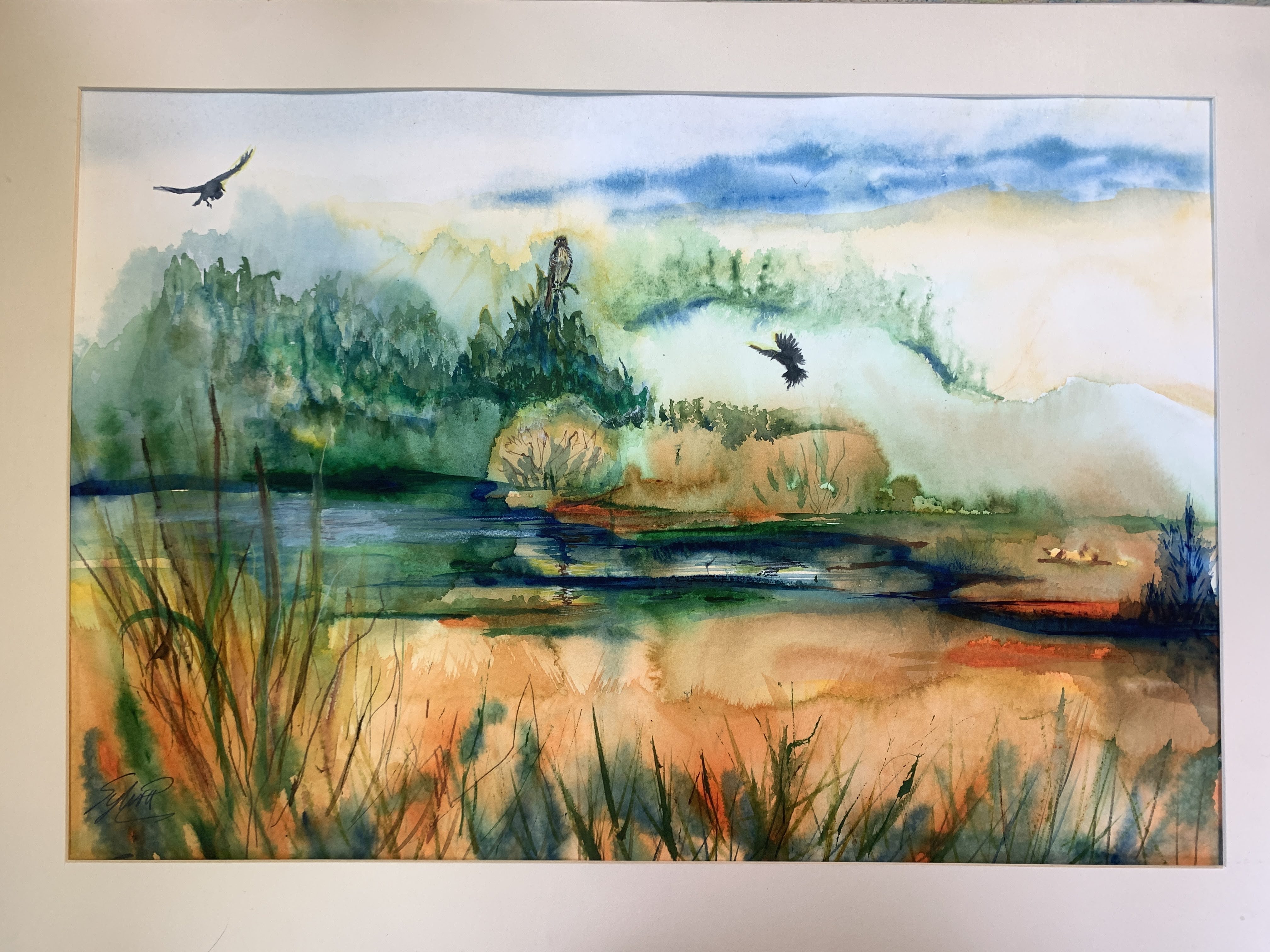
Roufus the Red Tailed Hawk perched majestically on the top of the Spruce, gazing over his meadow which surrounds Little Goose Lake.The trees swayed with the breeze, saying, “come play in my branches.” The warmth of the sun just touched the rounding tip of the spruce tree then landed on the rising mist. The sun filled Roufus with ambition and vision. The Hawk knew that the peace would not last for long as he heard the call from the edge of the woods.
“ Cwah, Cwah”, they came closer and closer,and then the sounds stopped. But he could hear the flapping of their wings. “I will stay still and tall and perhaps this day they will just fly by,” he thought as he ruffled his feathers.
“Cwah” came the sound as Mylo and Krakaw swooped at him from behind. The crows “pounced” into the pastoral scene with all the playfulness of a puppy.
Roufus stayed still for as long as he could, ignoring the swooping, pecking and cawing.
Dive, “cwah”, twizzle down in circles, flap back up, poke at the tail.
Dive, “cwah”, twizzle down in circles, flap back up, poke at the tail.
“And so ends my solitude” sighs Roufus as he lifts up and off the tree to show them just how large he can be. “They are such pests. Why can’t they just leave me be, I’m not hurting anything.” He soars as the crows try to keep up, they peck at his legs as Roufus swats with his talon. Finally leaving them behind as he looks for another perch.
The next morning.
Roufus sits, they come, they pester,twizzle and poke. He lifts up, swats and soars, leaving them behind for another meadow. And so continues the daily routine. Mylo and Krakaw are protecting a bud of an idea, a beginning of something new. They are defenders of their meadow. Unable to see how Roufus is simply enjoying his perch, unaware of the growth below. Had they left him alone, he might not have noticed their secret.
Yet another morning.
Roufus sits, and waits for them to once again arrive. Maybe this time will be different. The crows pounce again.
Dive, “cwah”, twizzle down in circles, flap back up, poke at the tail.
Dive, “cwah”, twizzle down in circles, flap back up, poke at the tail.
Roufus lifts off the tip of the tree, But today he did notice, for as he pecked and clawed he lost his balance and his sharp eyes noticed something deep within the branches. Their pestering provoked his curiosity. He flies off but then ,he circles back around to those deep branches and spies their nest of eggs. Roufus snickers, this day has been different! Eggs for breakfast.
The next morning.
Roufus perched majestically on the top of the Spruce, gazing over their meadow which surrounds “Little Goose” Lake. The wind rustled across the grasses making it seem like a lion would emerge. The lake rippled and lapped the shore with its laughter. The trees swayed with the breeze, saying “come play in my branches.” The warmth of the sun just touched the tip on the spruce tree and landed on the rising mist on the lake. The Hawk hoped that the peace would last. But he heard the call in the distance. “Cwah, Cwah”. They came closer and closer.
“I will stay still and tall and perhaps this day they will just fly by, they have nothing to protect now, I am still much larger and stronger than them,” he thought as he ruffled his feathers. The sounds had stopped, but he could hear the flapping of their wings, many wings. “Cwah” came the sounds as Mylo and Krakaw swooped at him from behind. But others came with them. It was a murder of crows. Roufus was no longer above the rest. He lifted and tried to fly. They pecked and swooped, he dodged and clawed. The ruckus even disturbed the branches, grasses and lapping lake. Exhausted , Roufus (minus some plumage) left in search of another meadow.
Sanderlings – Under the Sea Wind
Listen to Excerpt from Under the Sea Wind by Rachel Carson
Read Excerpt from Under the Sea Wind by Rachel Carson
Excerpt from Under the Sea Wind
by Rachel Carson
(Rachel Carson’s work inspired me to be an avid outdoor teacher,
I discovered her book A Sense of Wonder and it has helped me be present, and live with a curiosity for my natural surroundings.)
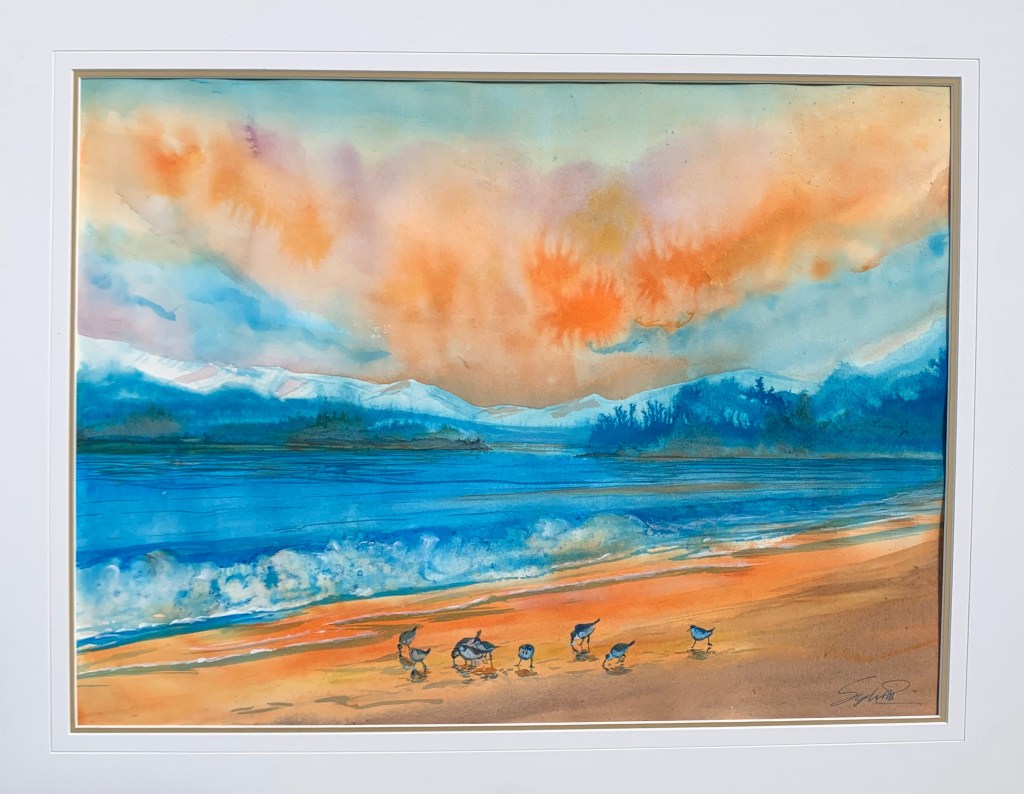
The night when the great run of the shad fish was passing through the inlet and into the river estuary was a night, too, of vast movements of birds into the sound country. At daybreak and the half tide two small sanderlings ran beside the dark water on the ocean beach of the barrier island, keeping in the thin film at the edge of the ebbing surf. They were trim little birds in rust and gray plumage, and they ran with a twinkle of black feet over the hard-packed sand, where puffs of blown spume or sea froth rolled like thistledown. They belonged to a flock of several hundred shore birds that had arrived from the south during the night. The migrants had rested in the lee of the great dunes while darkness remained; now growing light and ebbing water were drawing them to the sea’s edge.
As the two sanderlings probed the wet sand for small, thin-shelled crustaceans, they forgot the long flight of the night before in the excitement of the hunt. For the moment they forgot, too, that faraway place which they must reach before many days had passed—a place of vast tundras, of snow-fed lakes, and midnight sun. Blackfoot, leader of the migrant flock, was making his fourth journey from the southernmost tip of South America to the Arctic nesting grounds of his kind. In his short lifetime he had traveled more than sixty thousand miles, following the sun north and south across the globe, some eight thousand miles spring and fall.
The little hen sanderling that ran beside him on the beach was a yearling, returning for the first time to the Arctic she had left as a fledgling nine months before. Like the older sanderlings, Silverbar had changed her winter plumage of pearly gray for a mantle heavily splashed with cinnamon and rust, the colors worn by all sanderlings on their return to their first home. In the fringe of the surf, Blackfoot and Silverbar sought the sand bugs or Hippa crabs that honeycombed the ocean beach with their burrowings. Of all the food of the tide zone they loved best these small, egg-shaped crabs. After the retreat of each wave the wet sand bubbled with the air released from the shallow crab burrows, and a sanderling could, if he were quick and sure of foot, insert his bill and draw out the crab before the next wave came tumbling in. Many of the crabs were washed out by the swift rushes of the waves and left kicking in liquefying sand. Often the sanderlings seized these crabs in the moment of their confusion, before they could bury themselves by furious scrambling. Pressing close to the backwash, Silverbar saw two shining air bubbles pushing away the sand grains and she knew that a crab was beneath. Even as she watched the bubbles her bright eyes saw that a wave was taking form in the tumbling confusion of the surf. She gauged the speed of the mound of water as it ran, toppling, up the beach. Above the deeper undertones of moving water she heard the lighter hiss that came as the crest began to spill. Almost in the same instant the feathered antennae of the crab appeared above the sand. Running under the very crest of the green water hill, Silverbar probed vigorously in the wet sand with opened bill and drew out the crab. Before the water could so much as wet her legs she turned and fled up the beach.
Rachel Carson
Snails, Peacocks, Roots and Wings
Listen to Snails, Peacocks, Roots and Wings
Read Snails, Peacocks, Roots and Wings
When I was deciding what to do with my life, a lofty goal when you’re only in High School. I was contemplating speech therapy, or art therapy. I enjoyed working with people, but at all costs I was avoiding being a teacher. My roots were in teaching. My entire family on my fathers side were teachers. At every opportunity they would say, “You’re going to be a great teacher someday”. And so the rebellious teenager would have none of that.
My mother was an artist, dancer, singer and actress. I would watch her draw so effortlessly and wish I could draw like that. I would always criticize my own drawing so much that I gave up trying. I wished I could be like her, but I was not willing to lay the roots. In high school you had to decide between electives and I couldn’t take both art and drama so I dove into acting. Theatre became my creative outlet. I revelled in the attention, the chance to play with people onstage, and help each other reveal character traits.
At that time, I had a ‘success premonition’ dream. I was looking down at myself looking up and I had a fabulous red dress on with a scoop neck fitted waist and a full skirt. My expression was one of satisfaction and joy as I looked up embracing the world. That dream stayed with me as I awaited its fulfillment.
In college I prepped for speech therapy. I guess that choice was a love for speaking in acting merged with a viable income. I also took acting classes and got many roles that kept my fires burning until I finally decided to get a degree in theatre. I truly wanted to act but once again I had to make a choice. Would it be a B.A. where I could get a combination- some acting and some tech training or a BFA in acting which was competitive and intense? I was worried about making an income and became scared of my competitors. The result was a BA in theatre where I discovered my niche for Stage Management. It was creativity mixed with people-work and organisation. (Hmmmmm sounds like the qualities of a teacher)
After my BA I became a professional stage manager. I rehearsed, worked backstage and toured. I worked days rehearsing and then evenings in productions. I was wearing out and not satisfied and needed some support and guidance.
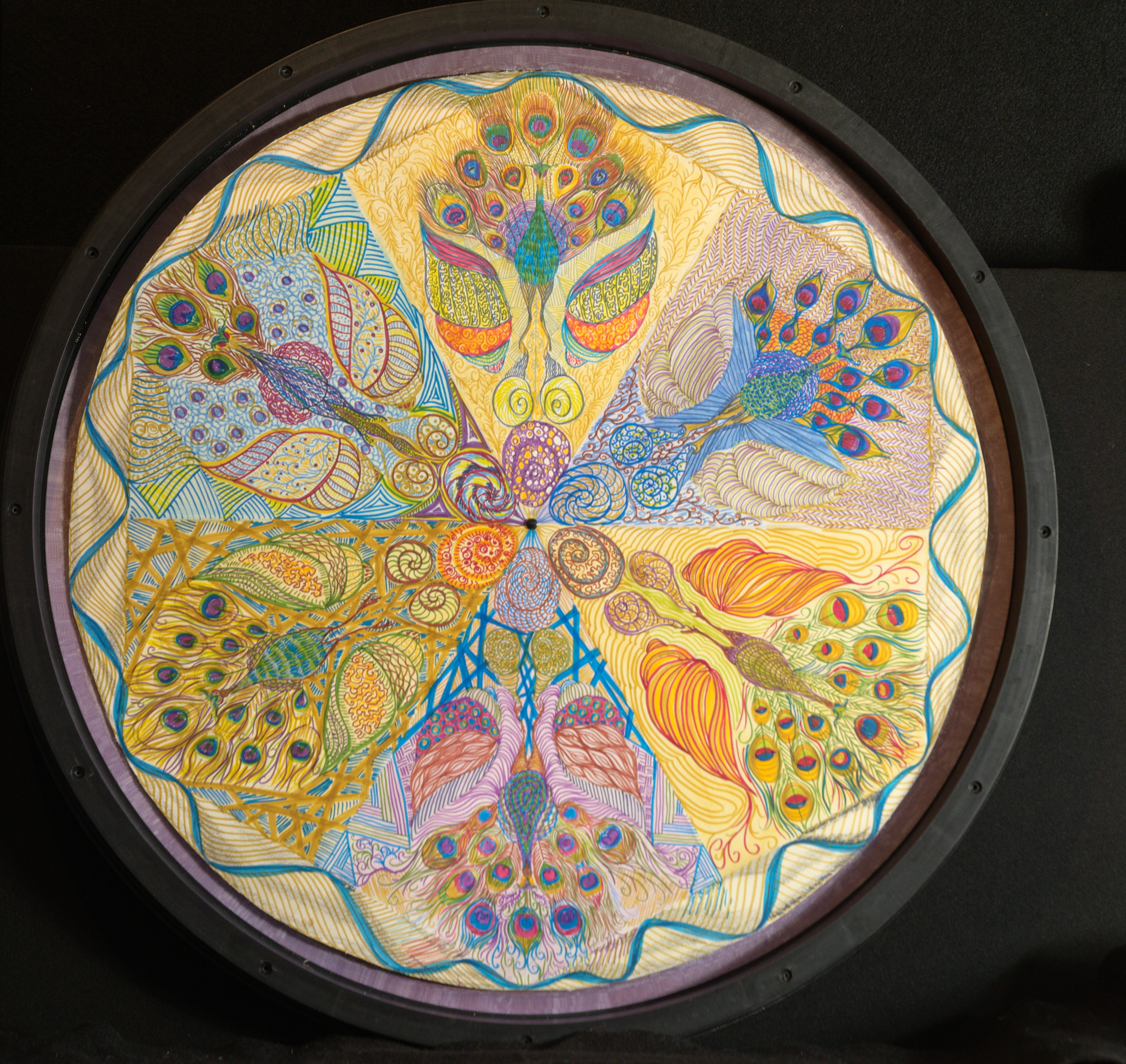
So I went to art therapy. I discovered my snail and peacock. My snail wants to cocoon in its shell, make a home and seek protection and comfort. Then the peacock is full of flutter and show, with creative colours strutting her stuff. In art therapy I discovered a free flow with instinct. I was able to reveal hidden messages in my subconscious that were hoping to come out. My brain kept getting in the way with overthinking and worry. Art became a release and I was able to move towards that inevitable career in teaching with art and theatre becoming a hobby.
I moved to Williams Lake where I had a teaching position and joined the Williams Lake Studio Theatre. I delved into acting again and found more joy. My children and I performed together in ‘Just So Stories’ and I cherished that time together. I continued to do artwork, and experimented with Zendoodles, taking a year to immerse myself in Snails and Peacocks. I trained as an outdoor educator and got a job opening the first nature kindergarten at Scout Island. I had put so much pressure on myself , I think I was running on fumes. Two teenage children, an acting role and developing a new nature program. I broke down and cocooned, a lost soul trying to find her place in the world, still. . .
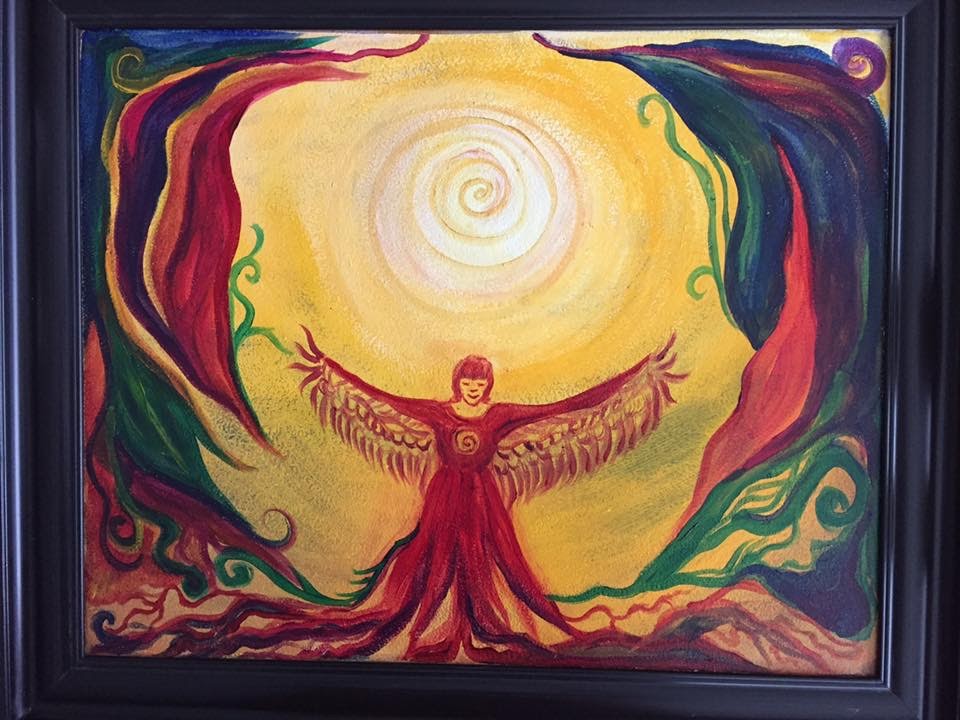
So in my snail shell, protected by a leave of absence in a life long career, I painted. Roots and Wings was a product of this process as I followed the annual February Opus daily Challenge and the prompt for Feb 14th was love. What emerged was this painting of roots and wings, a self love tribute that brings tears to my eyes as I write this, still trying to balance all my passions. I based it on that dream of me in the red dress, now I am looking inward supported by roots and still able to fly. As I later looked at the piece, I was surprised to see the torso and hands holding the small me. Once again my subconscious was speaking. “I have you. You are safe.” I was finding my flow which helped me move back to the waters of Vancouver Island. A choice where all the pieces seemed to swim into place. Well most of them.
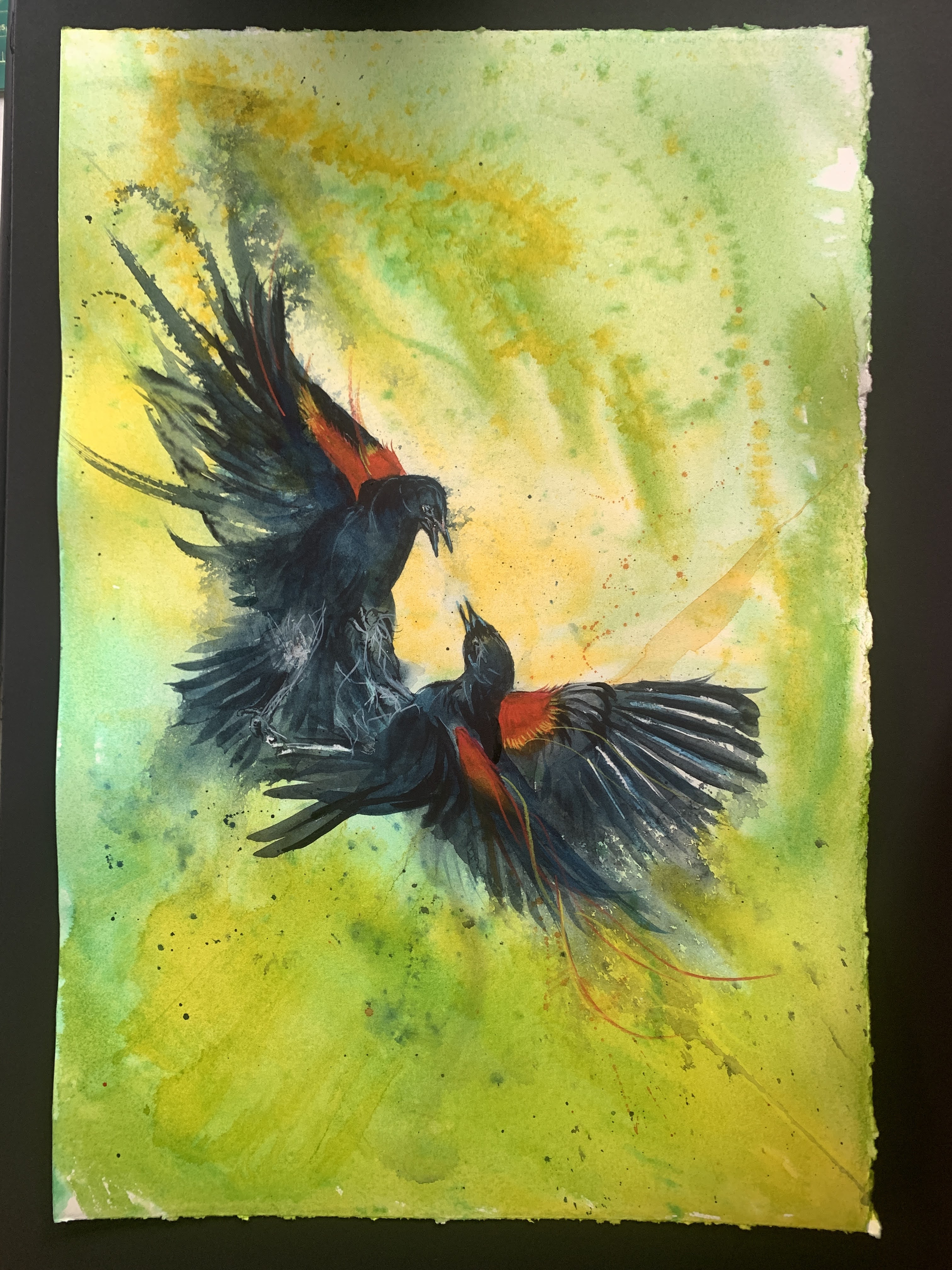
Red Winged Warriors of Love

Listen to the Red Winged Warriors of Love
Read the Red Winged Warriors of Love story
“Roweeerooooo” “oh cal eeeee” The sounds of spring in the Chilcotin
The Red Winged blackbirds would arrive en masse. The dark forms with red humps on their shoulders, there was a force to them and yet the sounds were so lilting and beautiful. Such contrast in the shiny black ebony, the bold red armoured warrior. Their flight was so direct and piercing.
My children and I would eagerly await their arrival in the spring. Winters were long but surprisingly bright up on the chilcotin plateau. The bird’s arrival would hint of the thaw to come after months of mud and puddles. That was a time of joy on our kilometre long driveway. Winter would carve out ruts and create many mud traps, but that didn’t stop us from making the driveway an adventure. With Kara’s head out one back window and Myles at the other, they would often fight as aggressively as the black birds for the best side. Poking their noses like beaks at the wind, I would drive up aiming to hit each puddle trying to spray mud on their faces. It was a fine balance of aiming and avoiding getting stuck. Just like the red winged blackbirds flight: purposeful, direct and then a quick flick up before landing.
I’ve been looking for stories about them for years, and found this one.
Chitimacha Story- from the marshes on the Gulf of Mexico–Why The Blackbird Has Red Wings
One day a man became so angry with everyone that he set the sea marshes on fire because he wanted to burn up the world. A little blackbird saw it. He flew up into a tree and shouted Ku naaaahm wi cu! Ku naaaaahm wi cu! The world and all is going to burn.”
The man said “If you do not go away, I will kill you.”
But the bird only kept shouting “Ku nam wi cu! The world and all is going to burn.”
Then the man threw a shell and hit the little bird on the wings, making them bleed. That is how the red-winged blackbird came by its red wings. Nowadays when the red-winged blackbird comes around the house, he still shouts “Ku naaaahm wi cu, Ku naaaahm wi cu.”
Folklore says they symbolize change, inner strength and a mastery of arts and justice.
For me they are the contrast of pain and pleasure in one being.
That chilcotin driveway holds memories of pleasure and pain for me.The joyous ride with my children and. . . the beginning of the end. As I drive us home, I throw his open beer can out the window and my husband jumps out of the car after it.
Their flashy plumage makes a statement. Between the creativity they show at nesting sites and their spirited efforts to protect their own, their personality and song keeps rivals away.
They are in my marsh on Vancouver Island year round. As defenders of our marshes, I’ve often watched them fight each other at the feeder.The aggressive adult trapping and stabbing a younger bird. Their beaks are like a piercing red arrow. When they fight, I’m reminded of the rough play my kids would enjoy, but not I. I always worried they wouldn’t know when to stop and that someone would get hurt. Yes, someone always got hurt or upset.
My grown children have recently had a difficult time in their respective lives. With each of their situations, I reacted, feeling angry and upset and I hated that I had reduced myself to that emotion. But there’s the rub. The anger and defensiveness of the red winged blackbird is helpful to the clan. In both of my children’s situations my anger showed a clear boundary that needed to be seen.
Seeing red can be helpful. It’s more protective than I realized and is also a symbol of love. Without the dark there’s no brightness.
Shawnigan Turkeys
Listen to Shawnigan Turkeys
Read Shawnigan Turkeys
Shawnigan Turkey’s
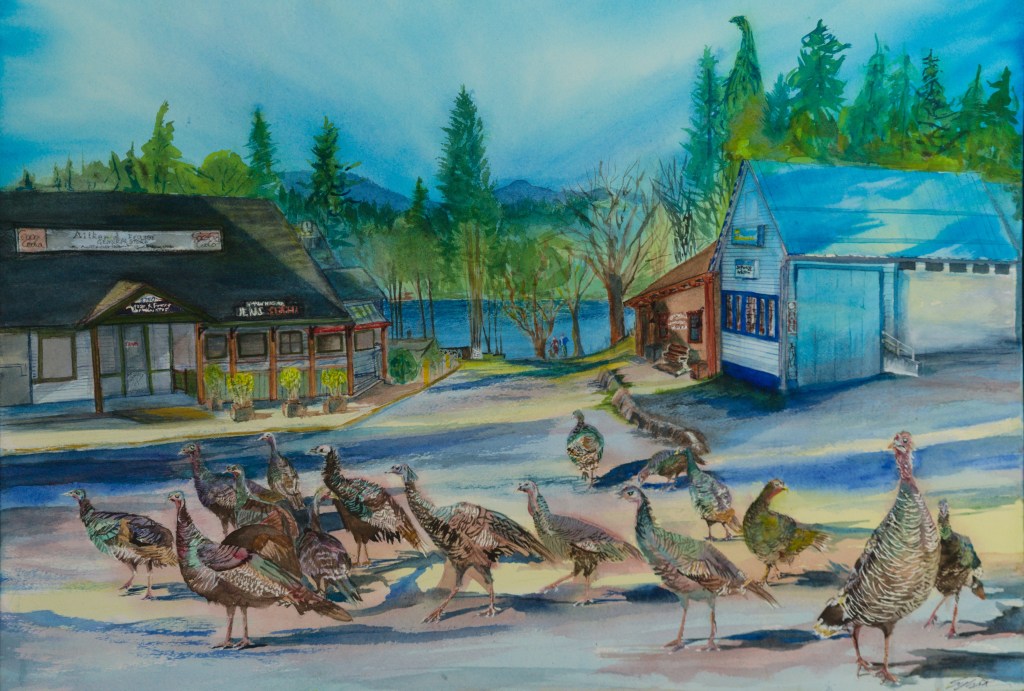
When I was looking for a place to call home, I drove through the quaint village of Shawnigan Lake. There was something about the way the store fronts invited you to join their charming community with the lake supporting it in the background.
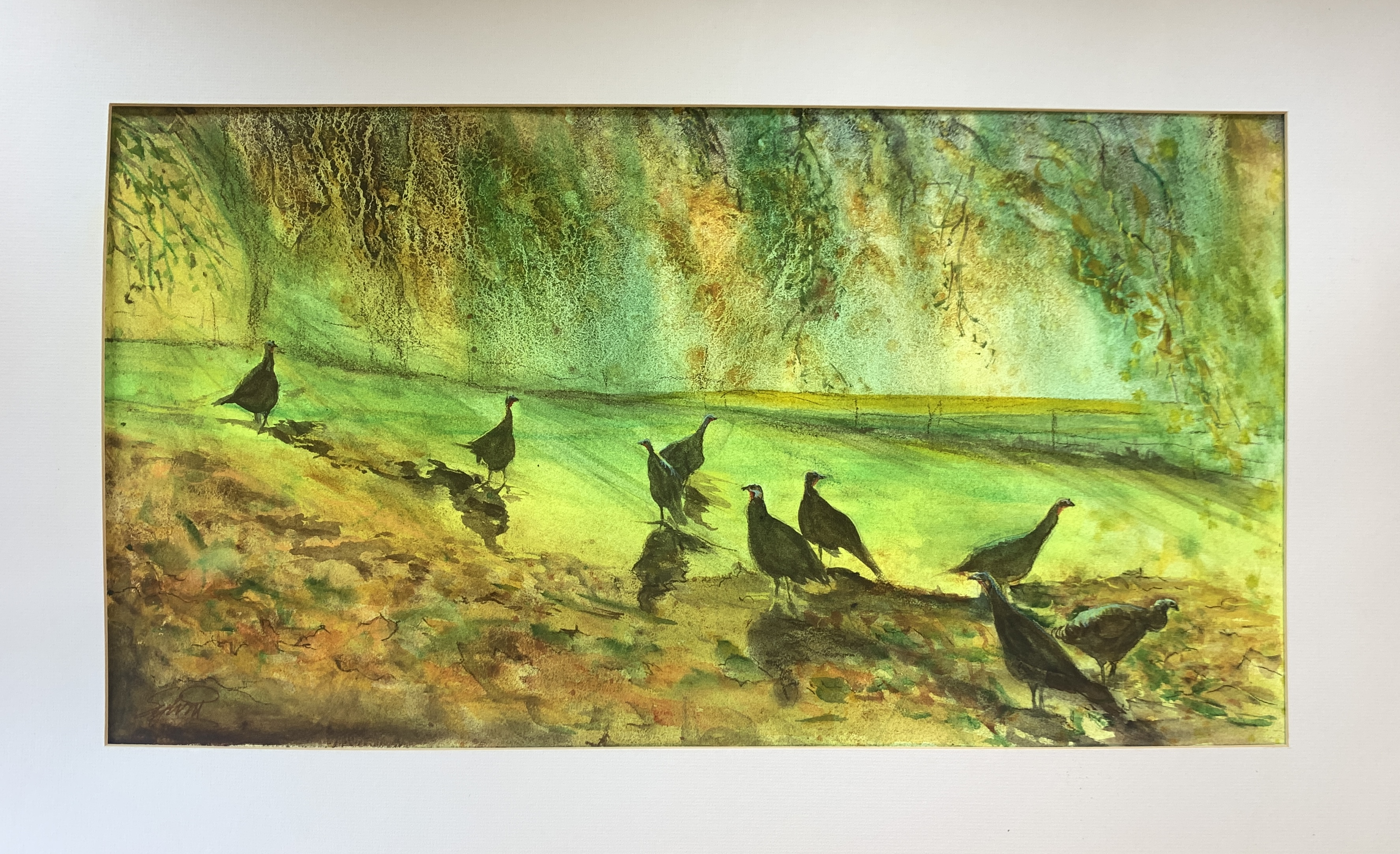
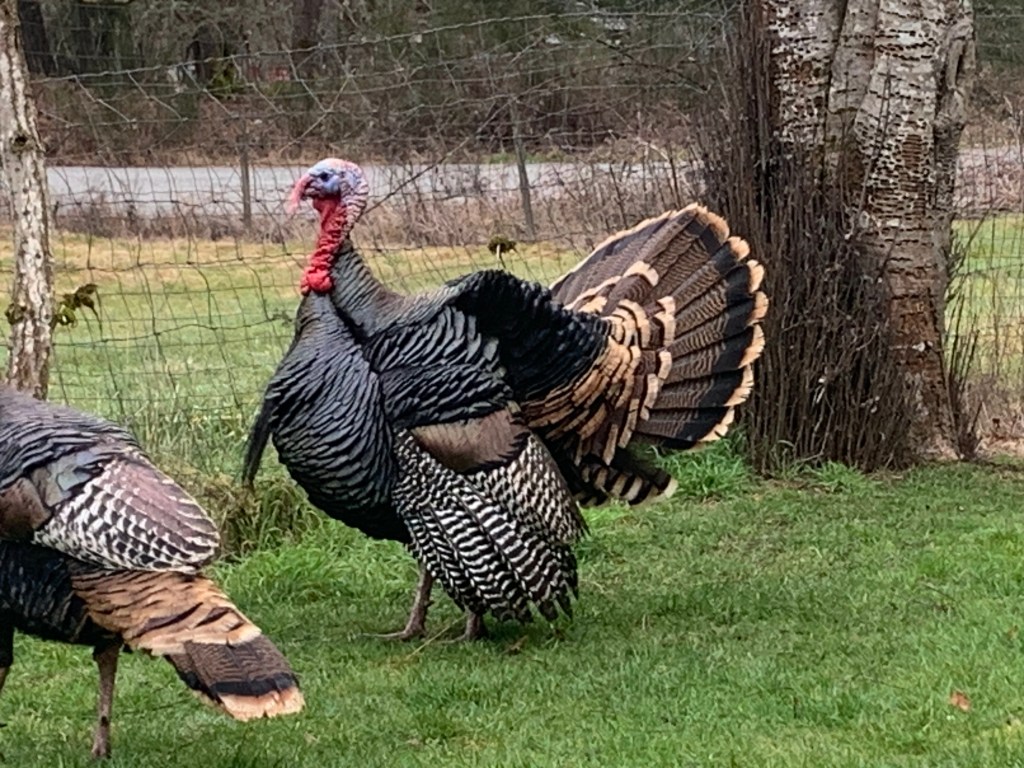
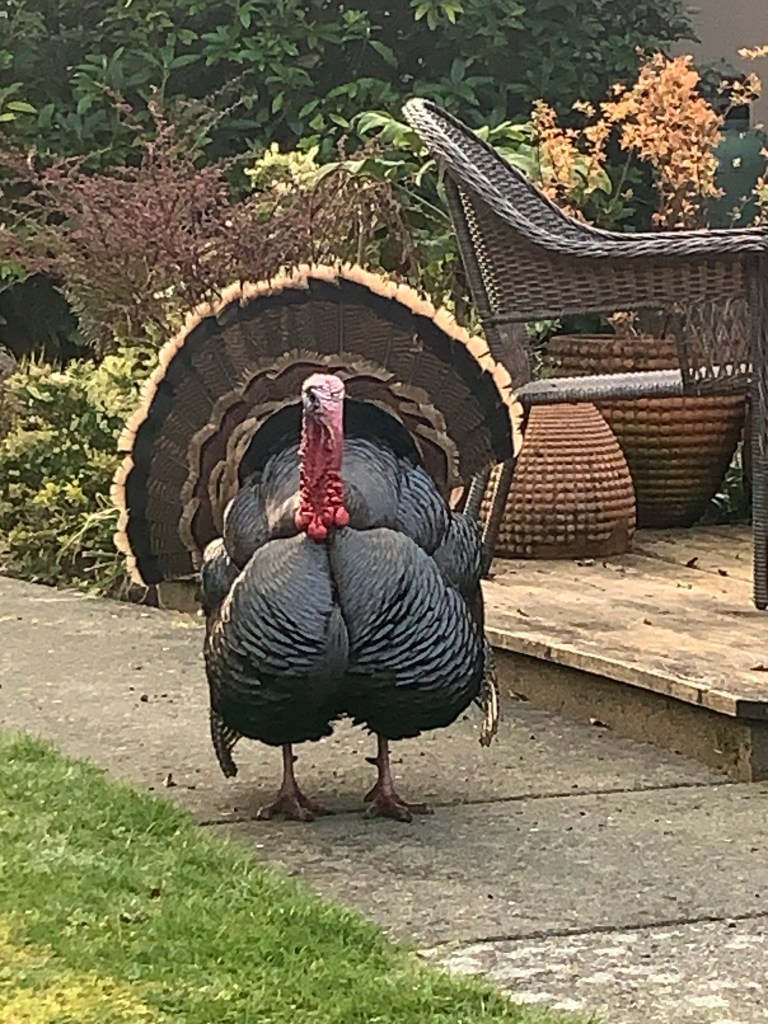
As I was leaving the village going towards Old Mill Park, there were turkeys on the road!!?? The traffic stopped and everyone knowingly waited for them to cross the road. I was completely amused and besotted by their calm attitudes, claiming their space as they walked.
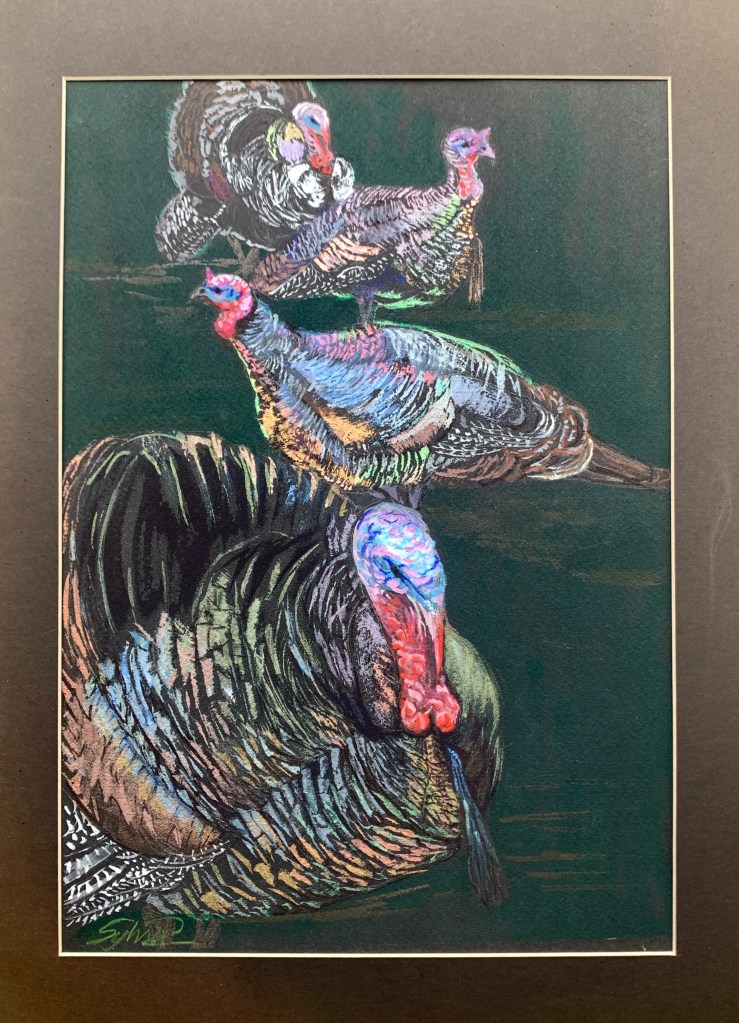
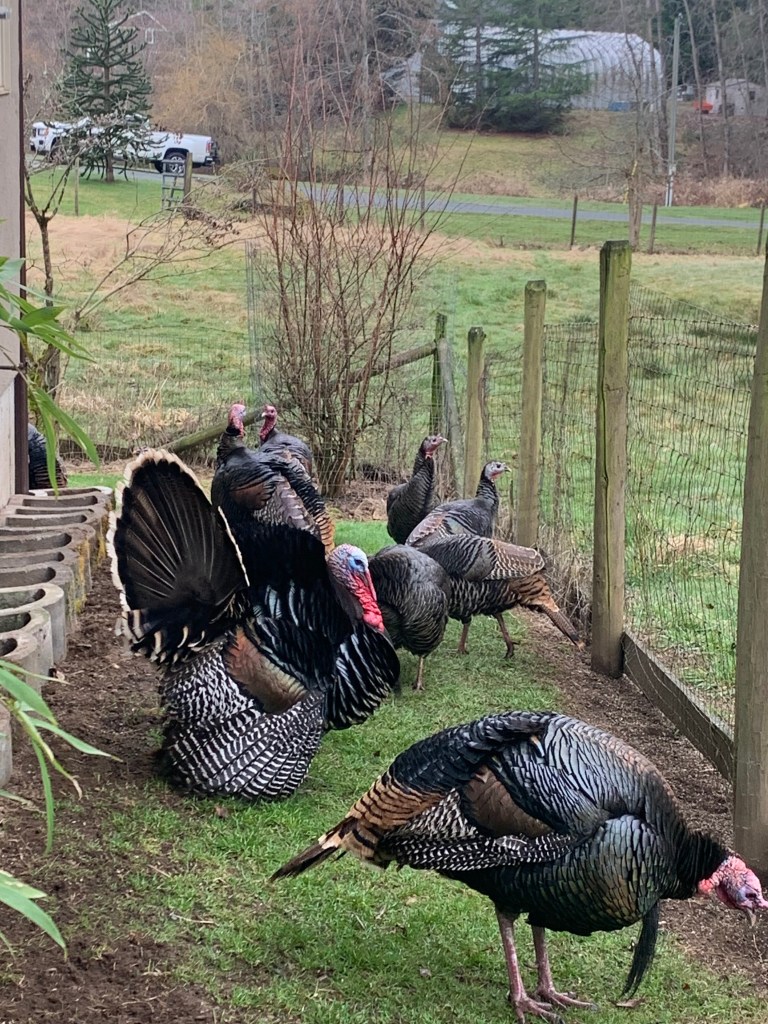
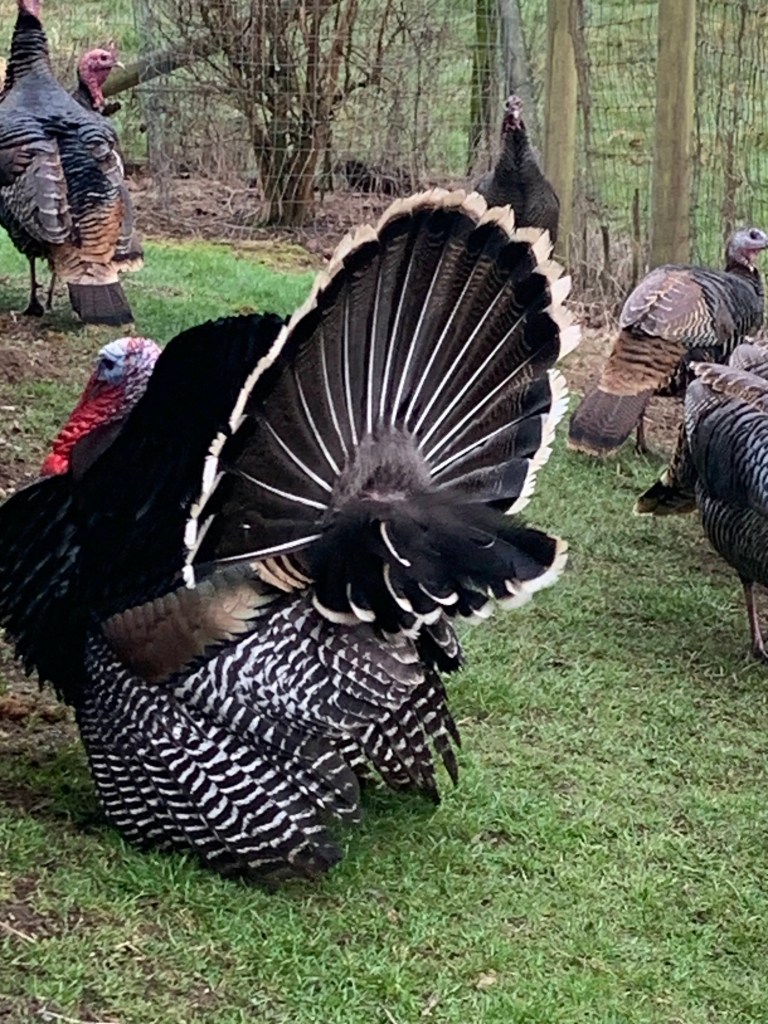
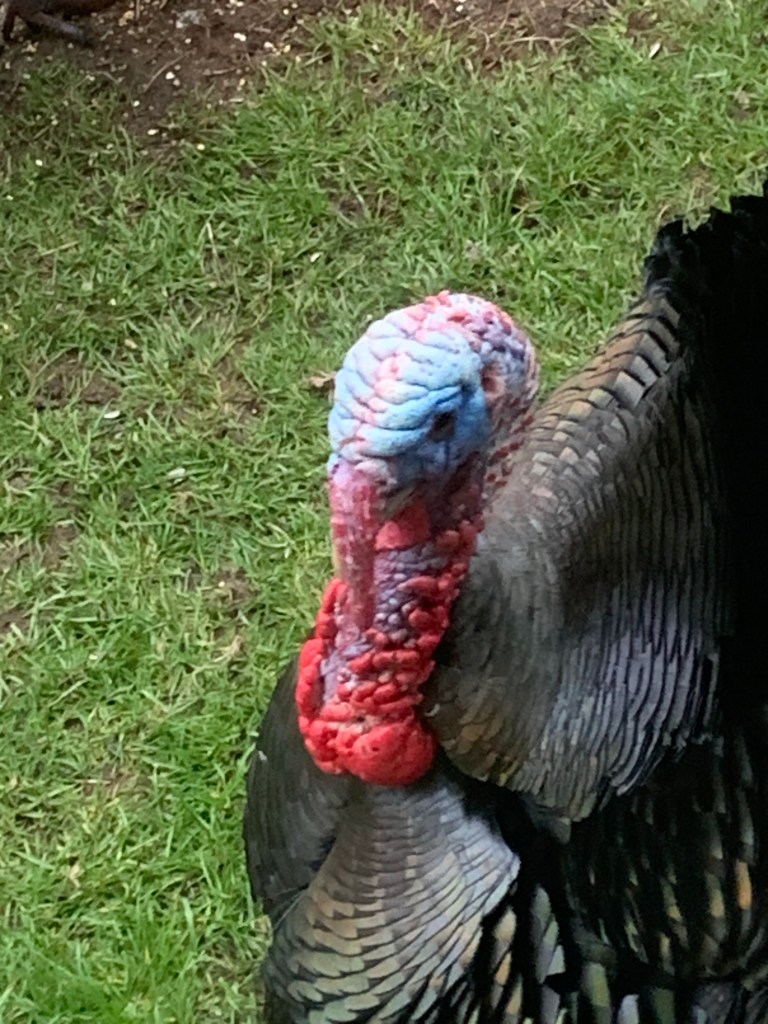
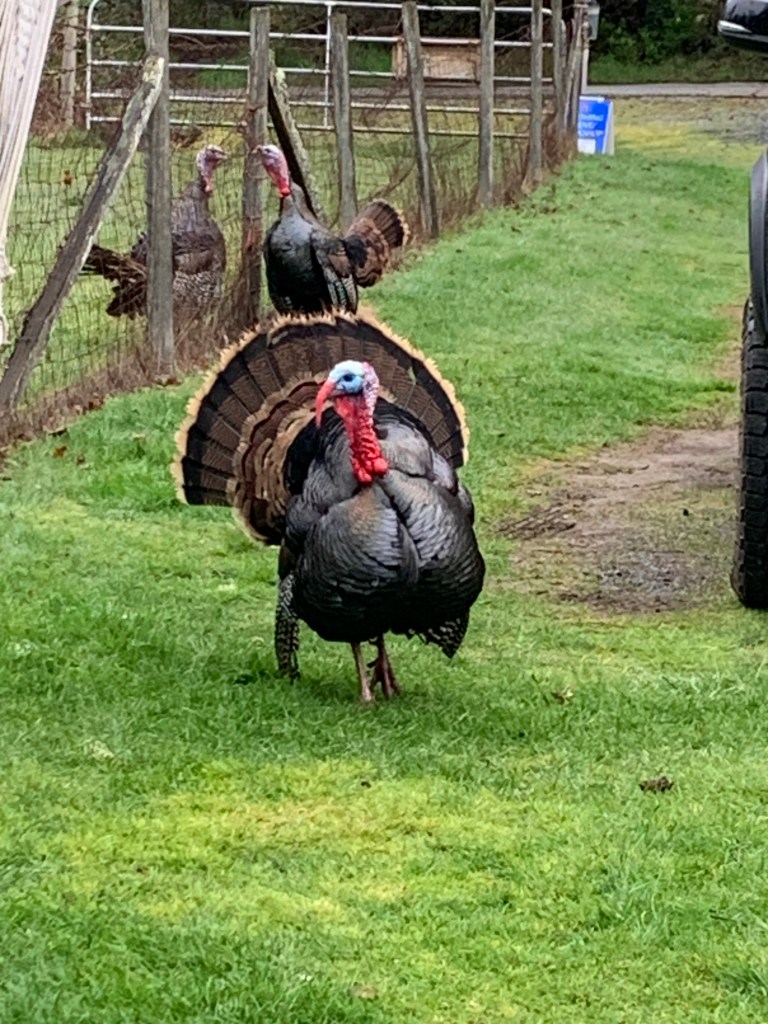
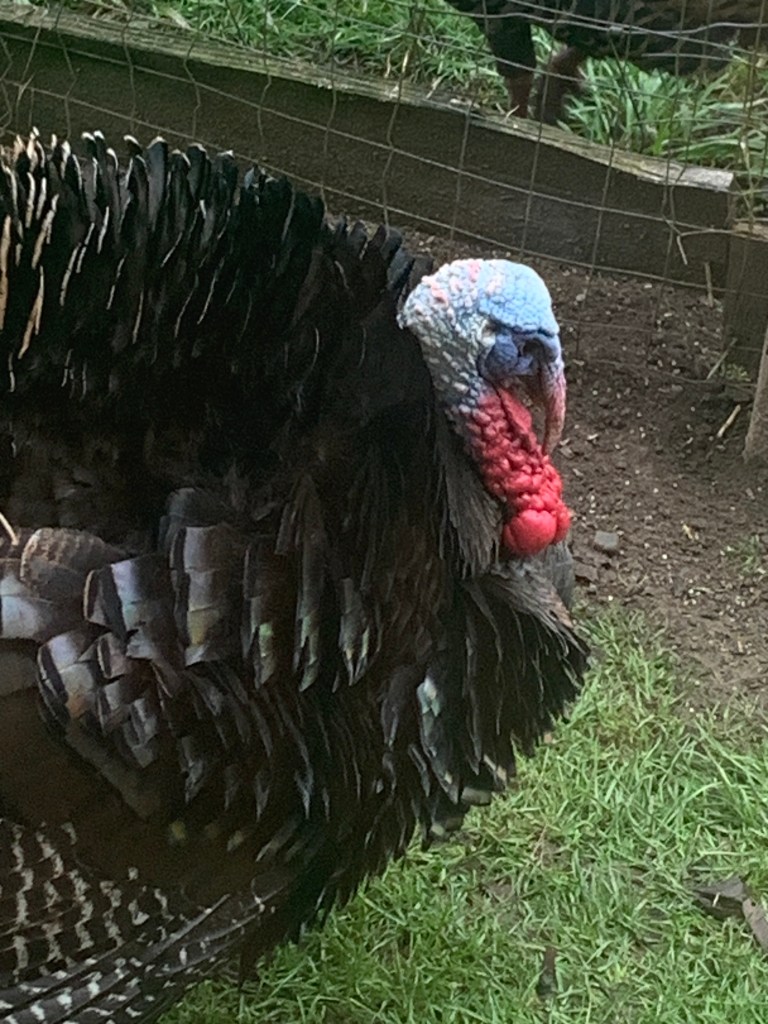
I got a teaching position at a local school in Mill Bay and we would go for nature walks on our weekly outdoor days. There was a beautiful property (Sanderson-Royd) owned by The Nature Trust of British Columbia, that we were allowed to roam, explore and discover. On our way there we would often see turkeys. I always wondered if it was the same bunch from Shawnigan or probably a near relative. In the spring the males would be busy fluffing themselves up and the kids took great enjoyment watching the display. Their colours were iridescent against their newly vibrant black plumage.
The caretakers and naturalists of the property were surprised to hear there were turkeys nearby as it’s not their usual habitat. But we had proof. There are stories in the community that a Homestead or Farm burned down and the owner couldn’t catch his turkeys so they let the flock go free. The reports go back 35 years.
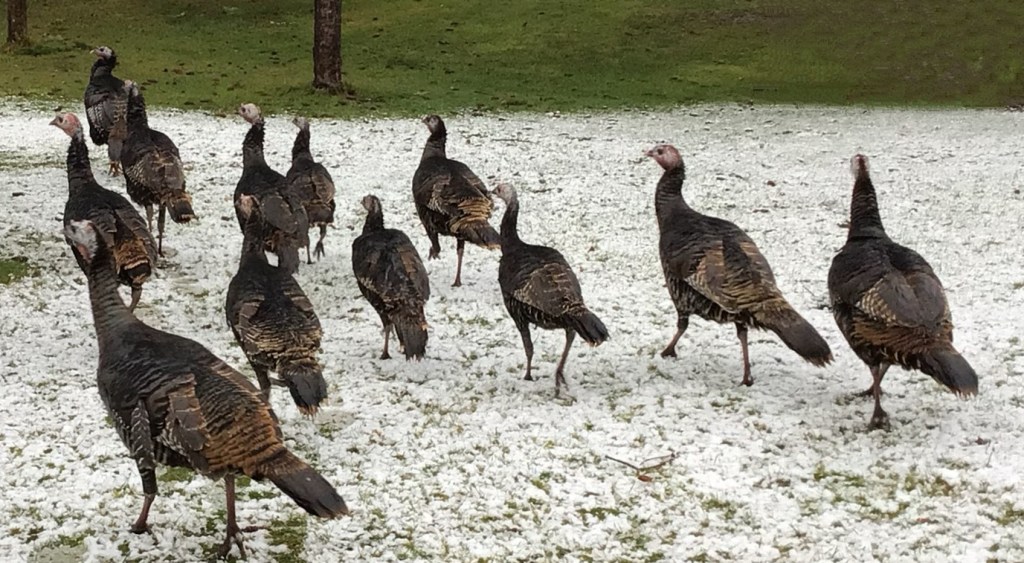
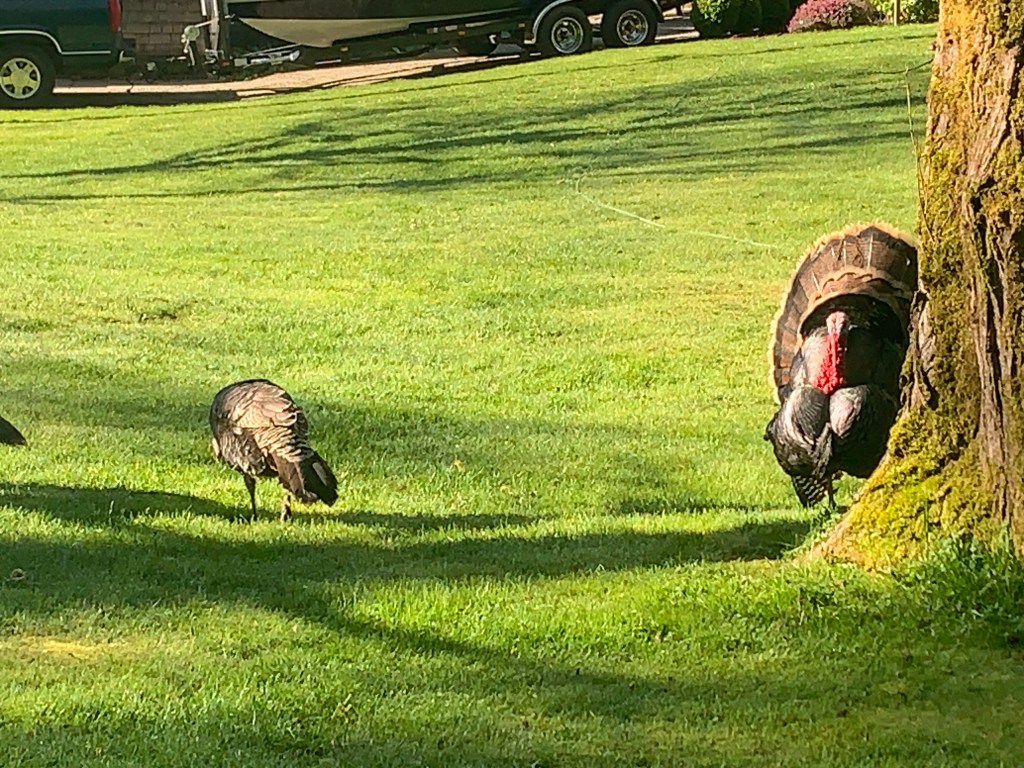
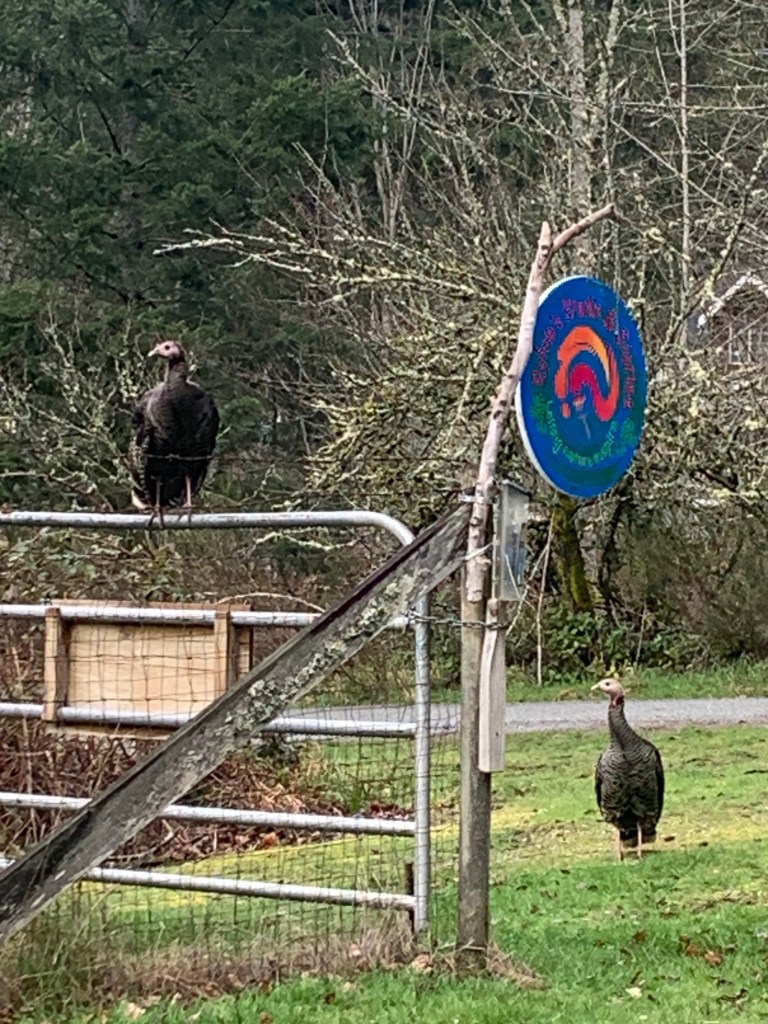
A couple of years ago, in my front yard, a female came by and I put out some bird seed for her. She was very picky and only went for the sunflower seeds. She became a regular visitor. At one point she ran very quickly from the blackberry bushes on the edge of the field towards me. I was shocked by her urgency. Within the week she had a trail of about 25 chicks following her. She must have been nesting. When I saw them from my window I came out slowly with sun flower seeds hoping to get close enough to observe them, she took two steps towards me, looked back at her flock and then went the other way. I didn’t see her again until the fall and the chicks were almost fully grown.
My neighbour was delighted to see the turkeys and had always wished they would become regular visitors, so between the two of us we managed to keep feeding them every day. They would run towards us as soon as our doors opened. Running turkeys are very amusing as they hop and fly around each other trying to get there first. One day as I was having a sad moment talking to my father, the turkeys were in the neighbouring field and the local Lab started to chase them. They all flew up into the trees. It was shocking and glorious to see them lift their own weight that high. Their flight and my fathers words managed to lift me out of my slump.
My daughter had been staying with me and I had her dog Cleo. The turkeys would be outside and staring up at my studio windows, impatiently waiting for me to come out. As I opened the door, Cleo ran out but my call stopped her from chasing them and they didn’t fly. They just cautiously kept a wide birth from her.
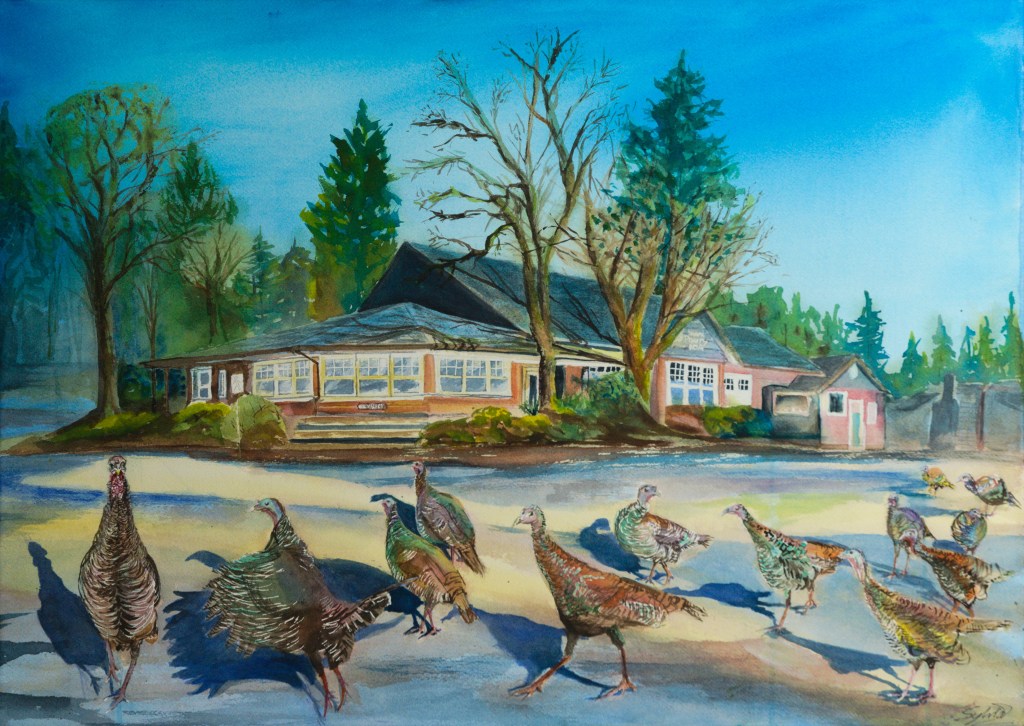
There were some downsides. The poop! Great big globs which sadly stopped me from going barefoot. They are frequent visitors now and the flock has grown. Their colour changes in the spring are something to be seen! They inspired my diptych – Shawnigan Turkey Crossing and the black watercolour – Iridescent Turkeys.
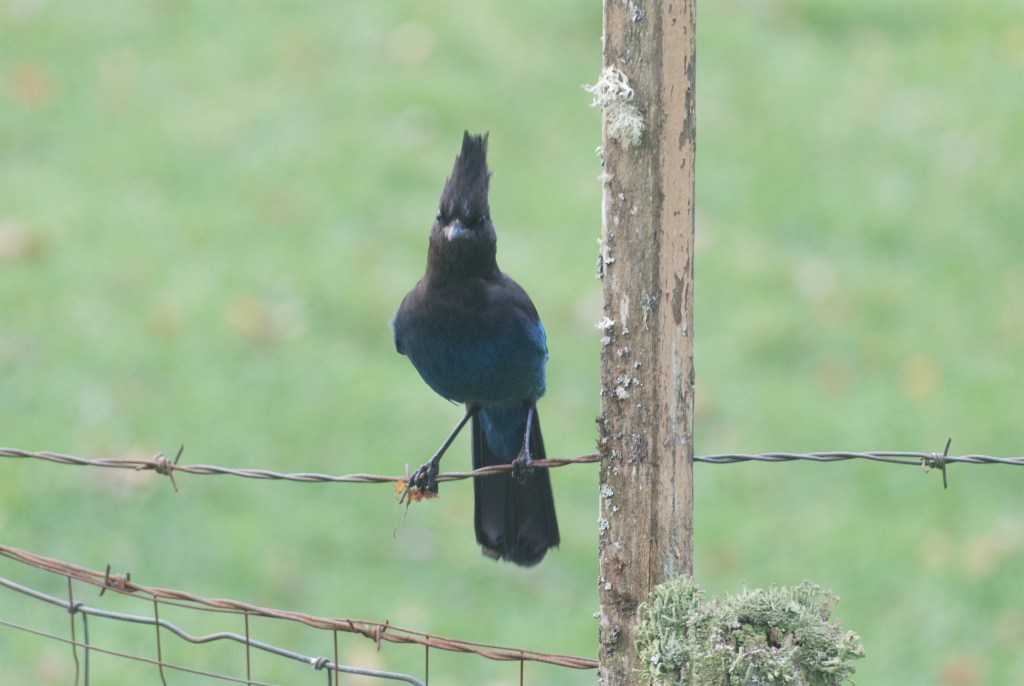
Loud, Curious and Bold – Steller’s Jays
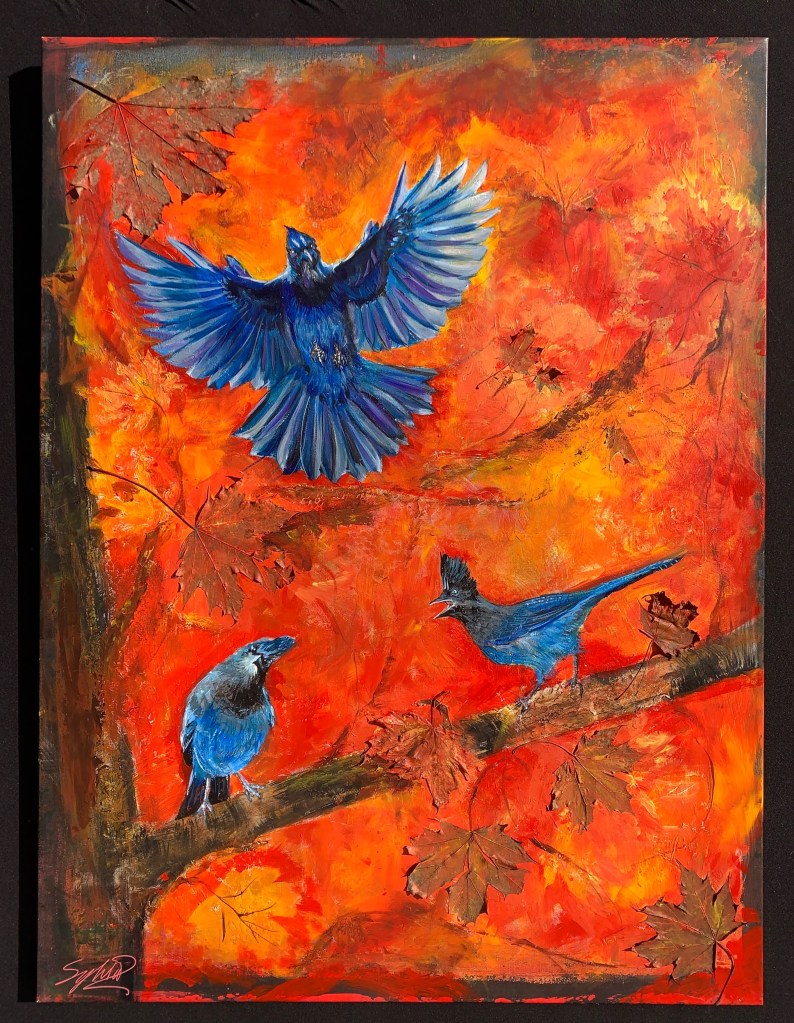
Stellers Jay
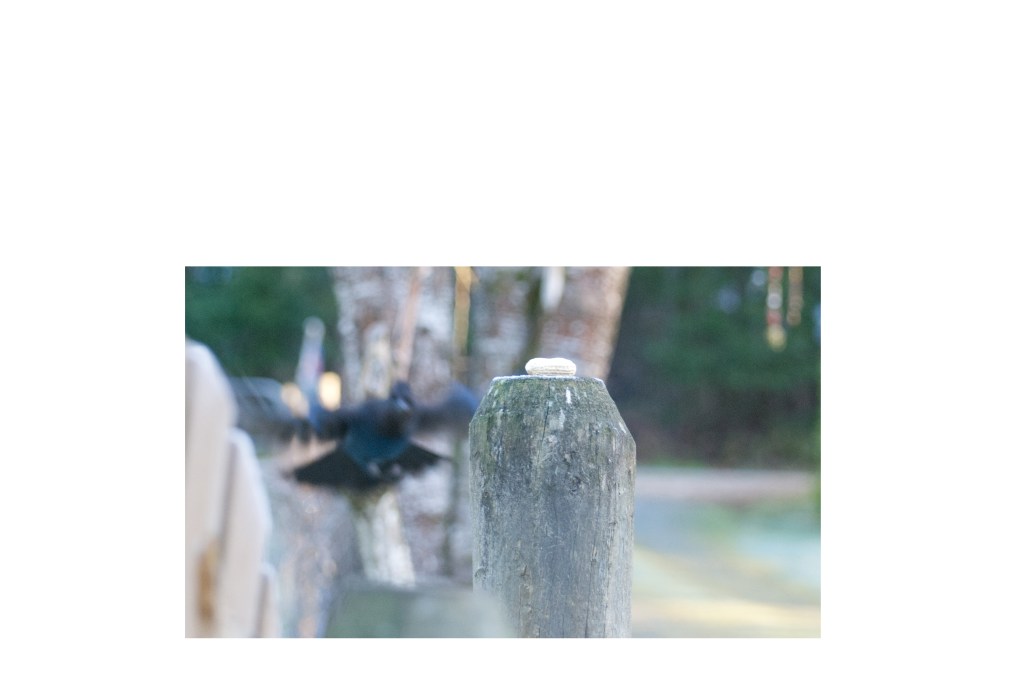
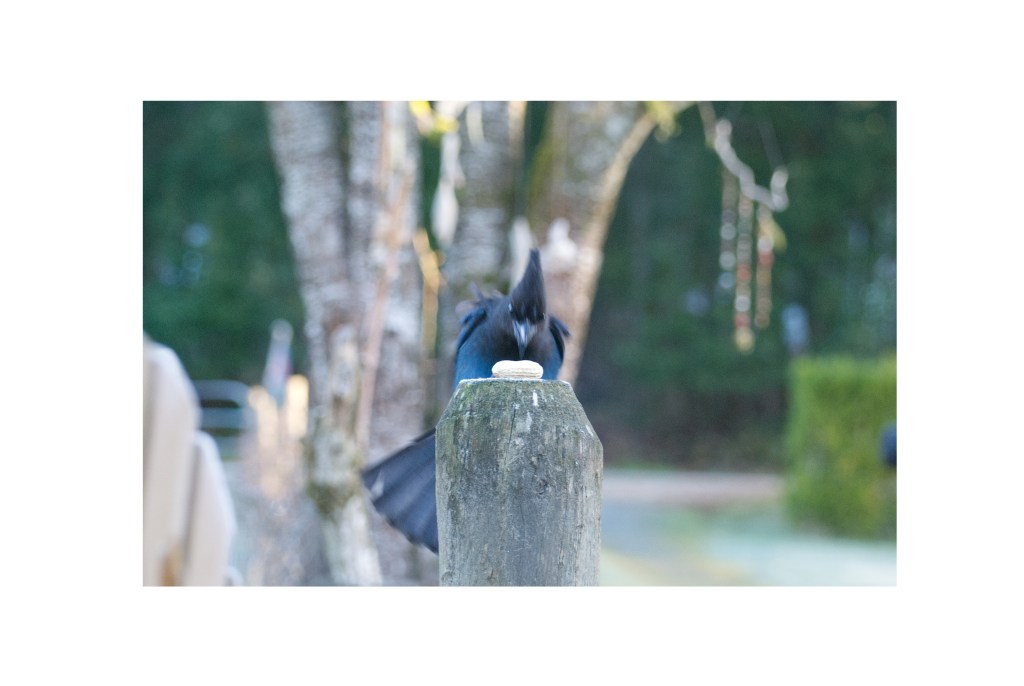
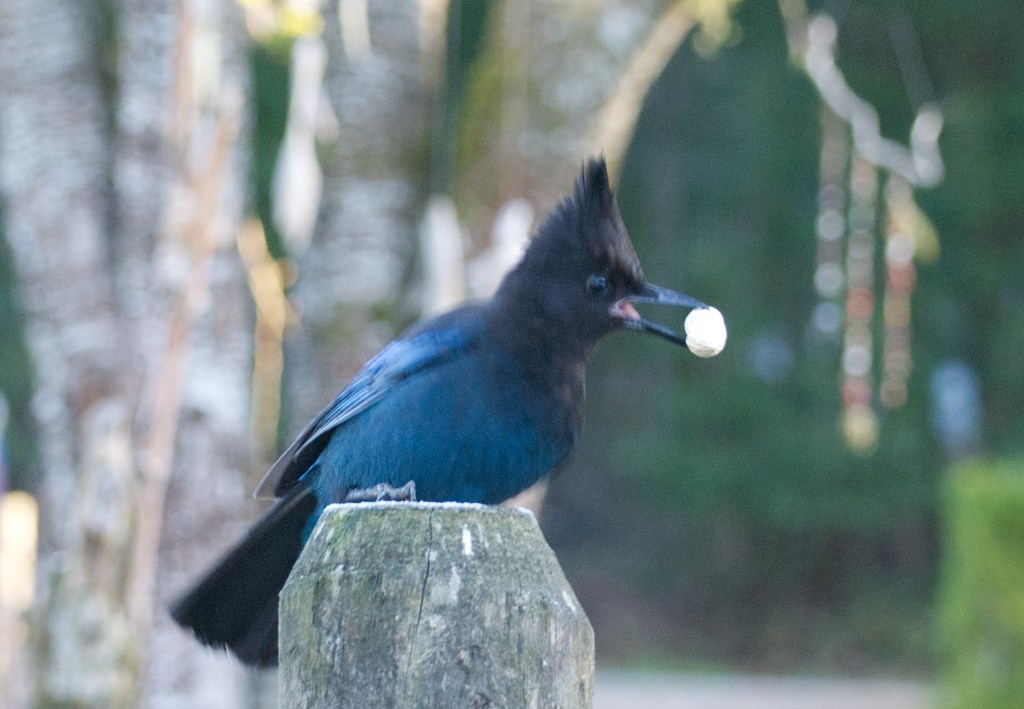
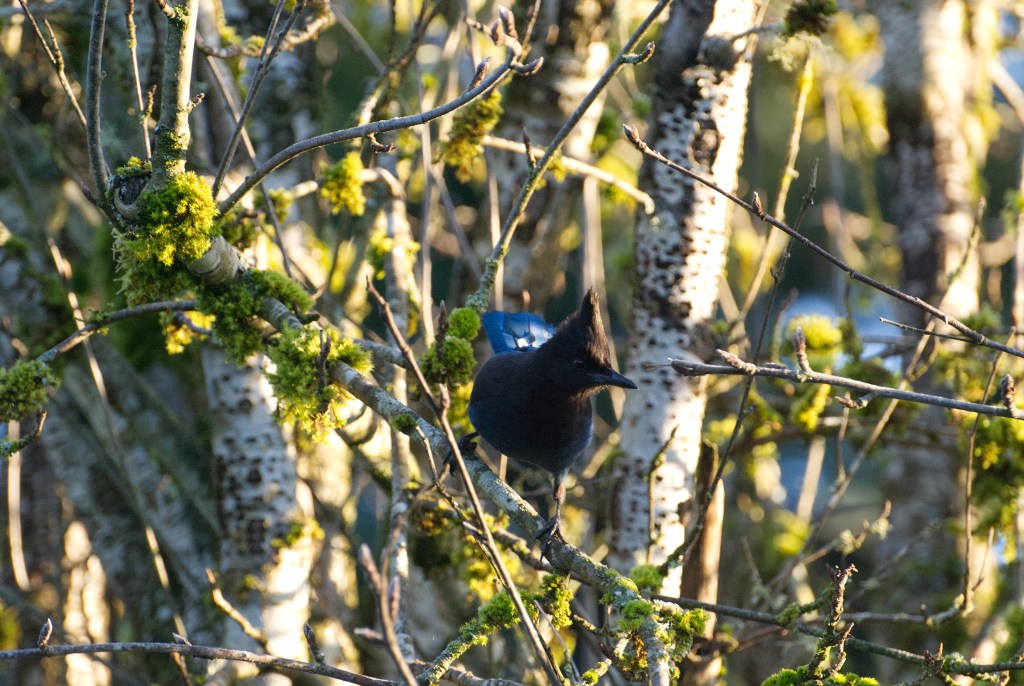
An arrow flicker of blue out the window
Flit flit flee and a stab for seeds
Woosh vibrant cobalt wings
Against the ochre orange maple
Partnered forever they pounce and prance.
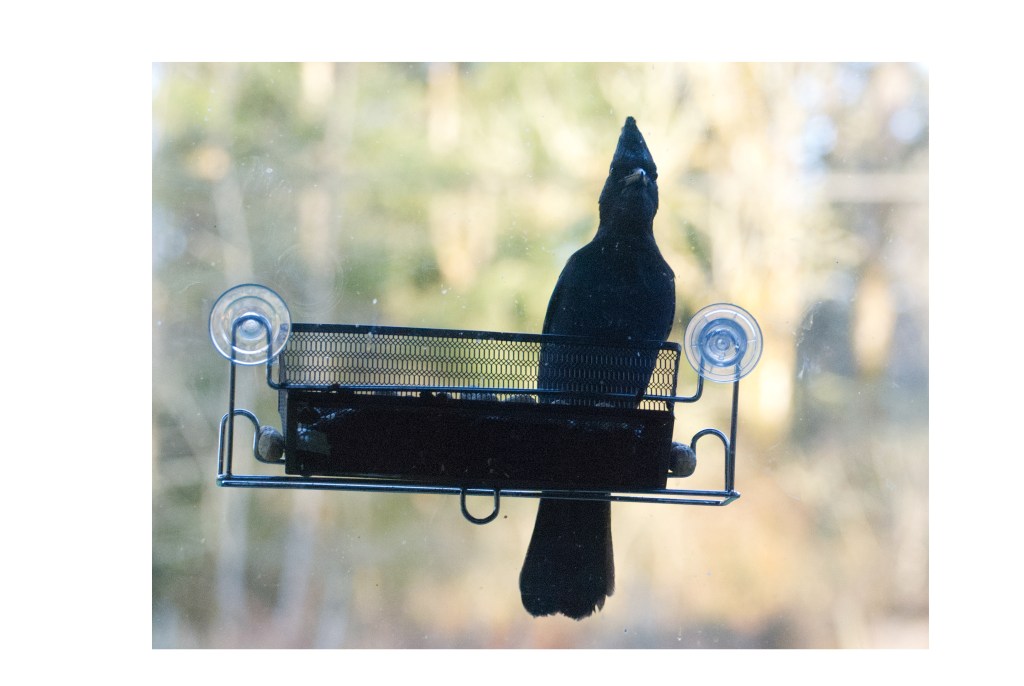
Mothers late with peanuts “Wah, Wah, Wah”
Tap Tap Tap on the window
My mom named them the peanut pack
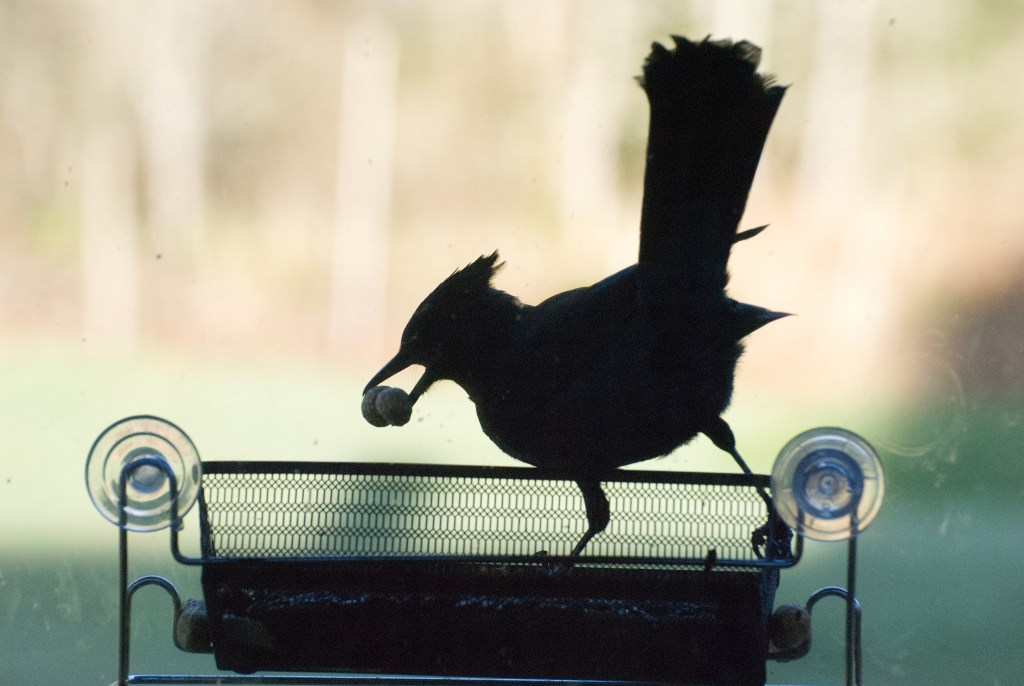
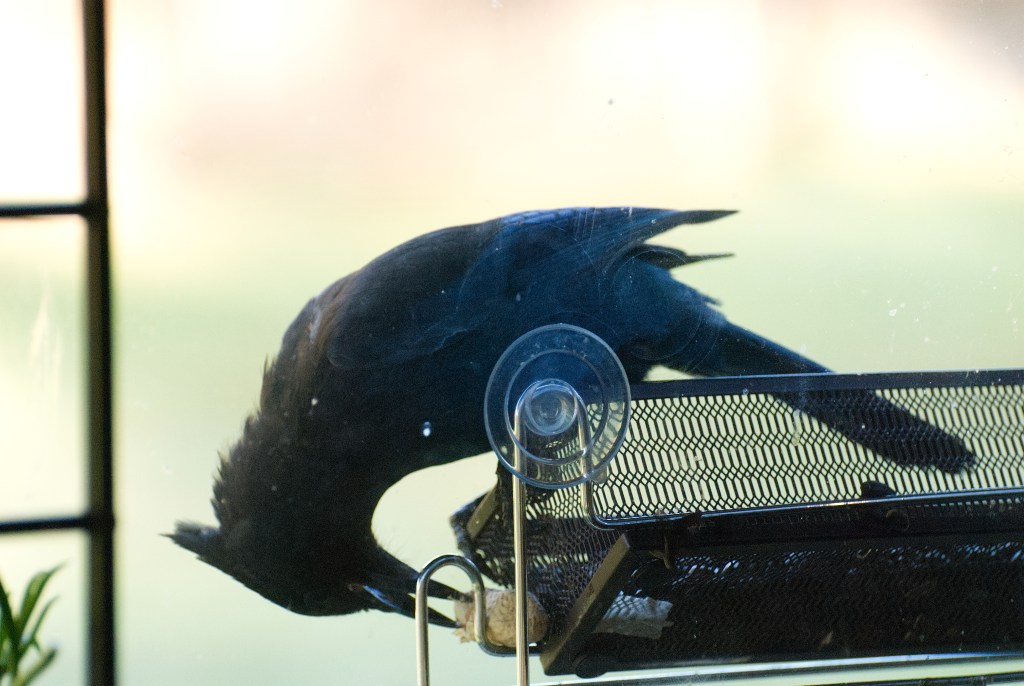
Piggy- takes two peanuts at a time
Poppy – is in and out as fast as possible
Picky- a ditherer unable to make up its mind
We follow
Picky questions with a tilt of the head.
Provoking curiosity and the possibilities of play.
Attacking and spearing
a hornets nest-a-buzzing
Braving the sting a-ring-a-ding-ding
Witness the nest transported to a meadow
Drop-a-plop-plap wasps parlay
Leaving the larvae for breakfast
Encounters with Robins
Listen to Encounters with Robins
Read Encounters with Robins
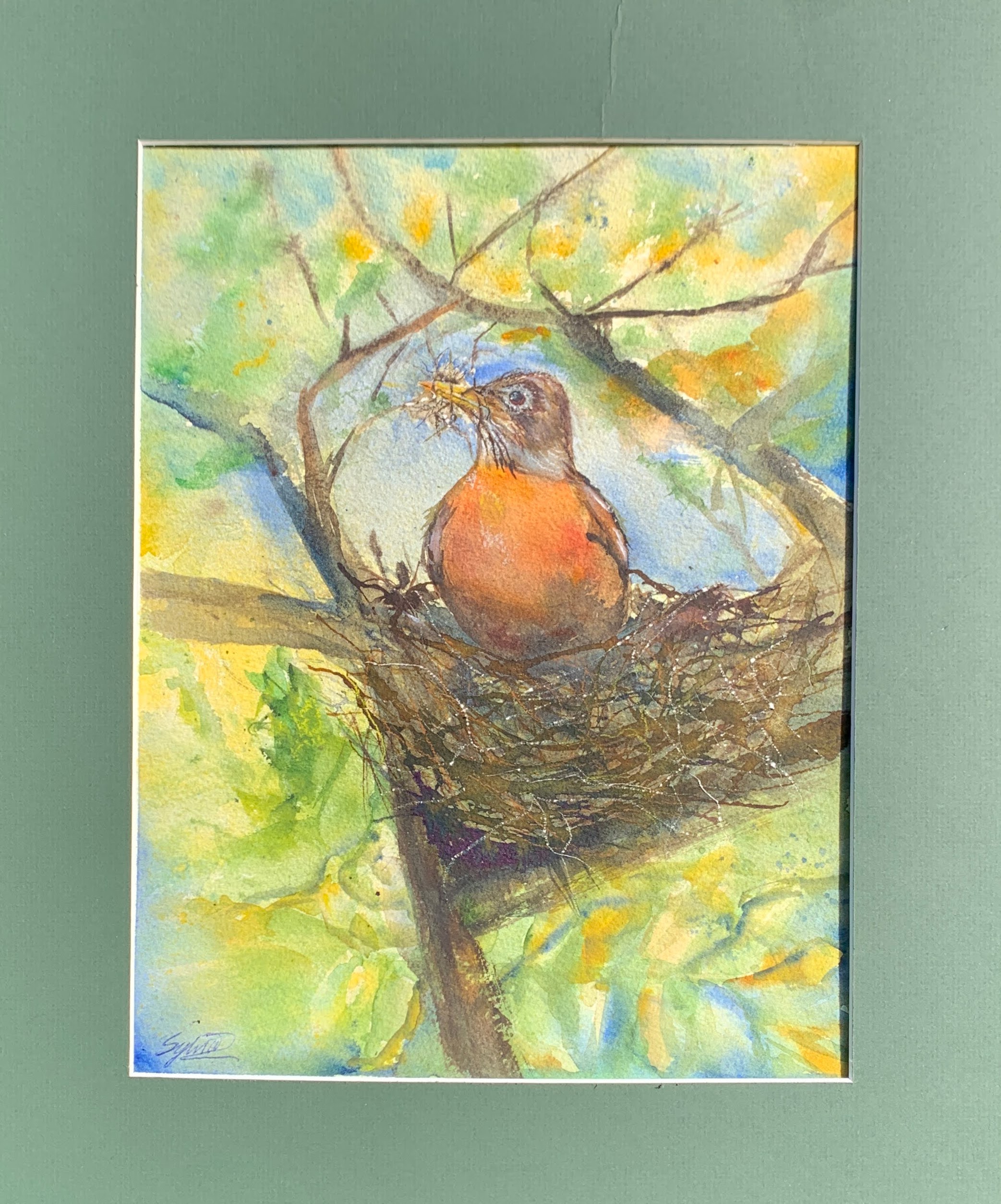
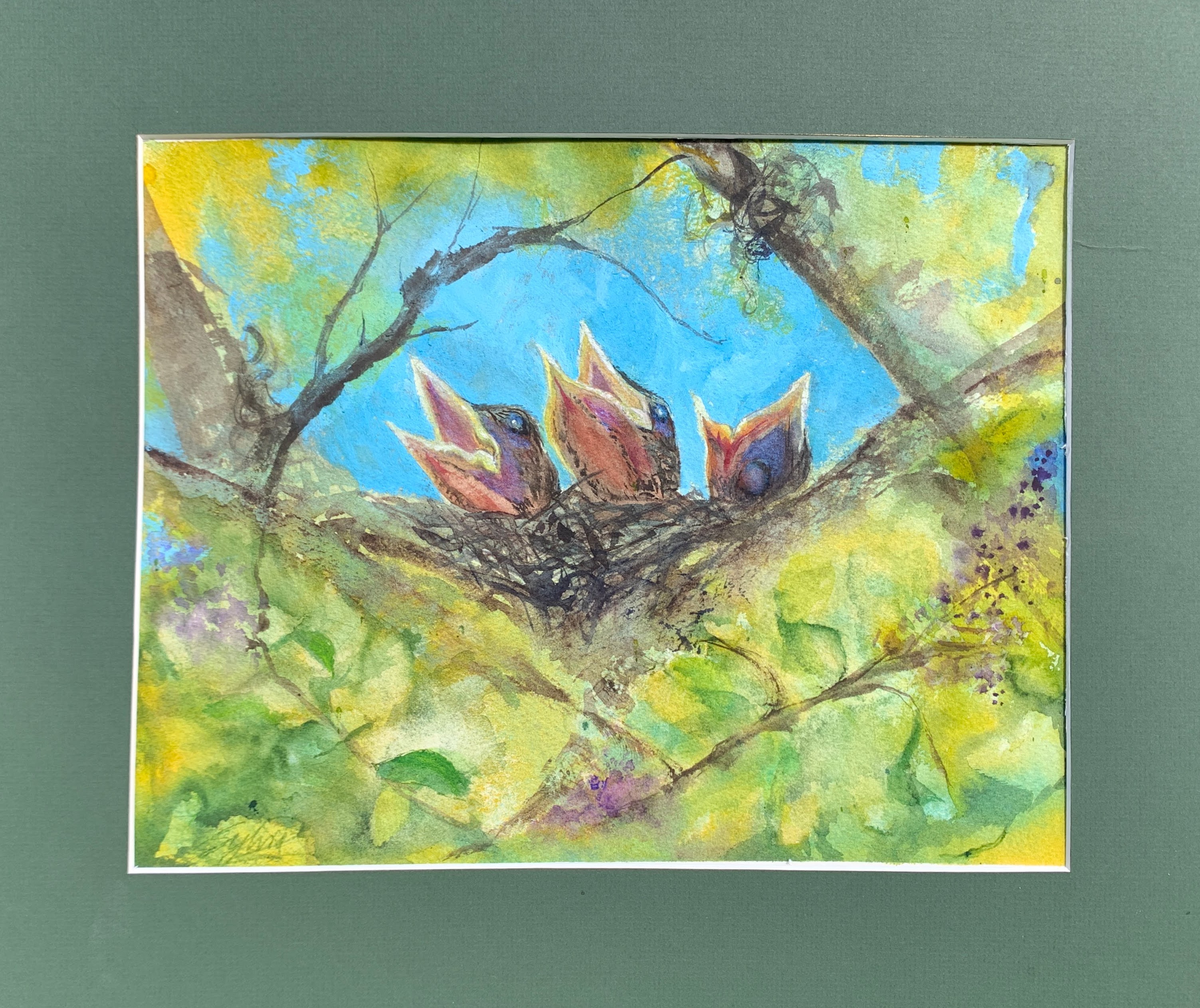
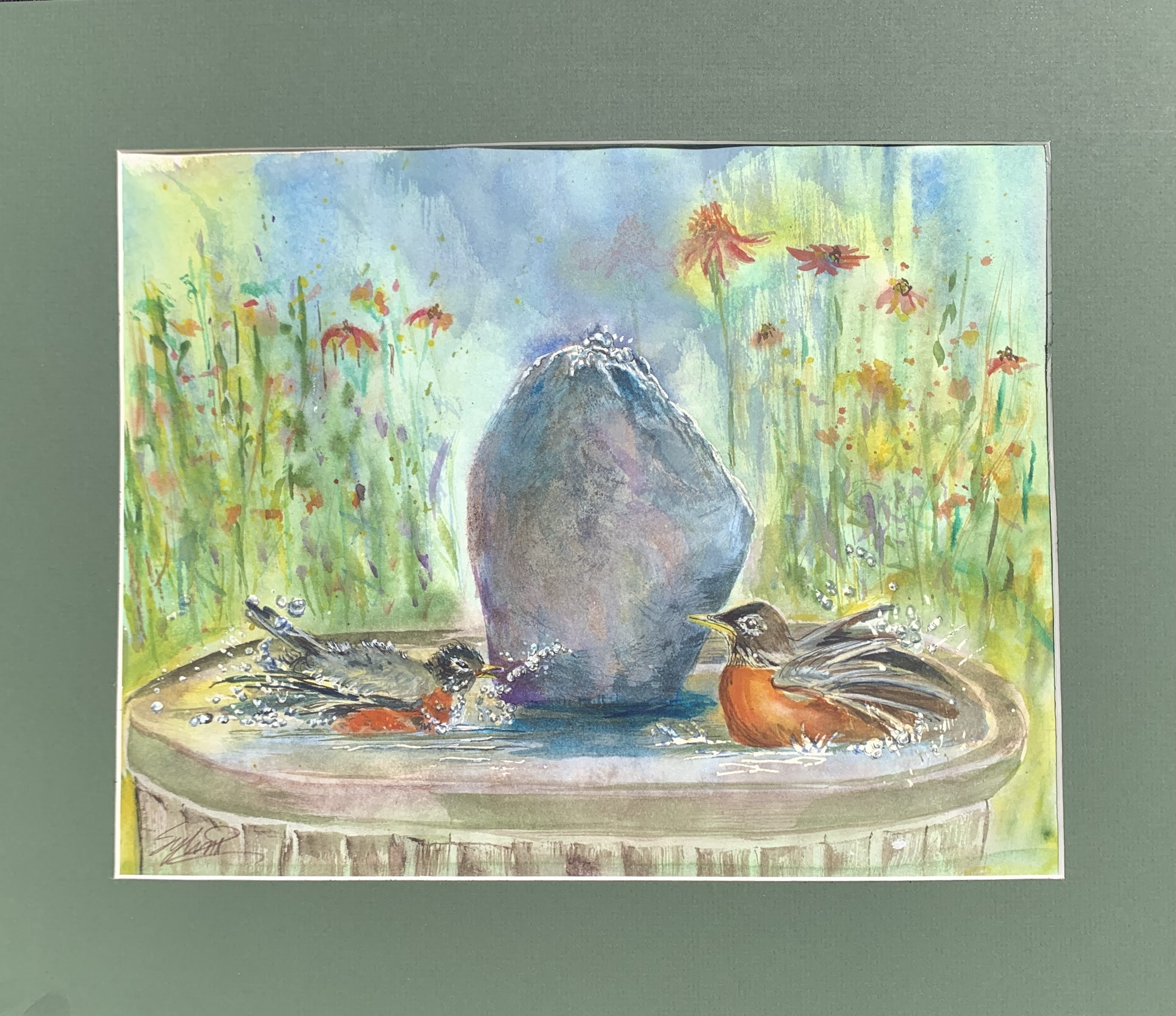
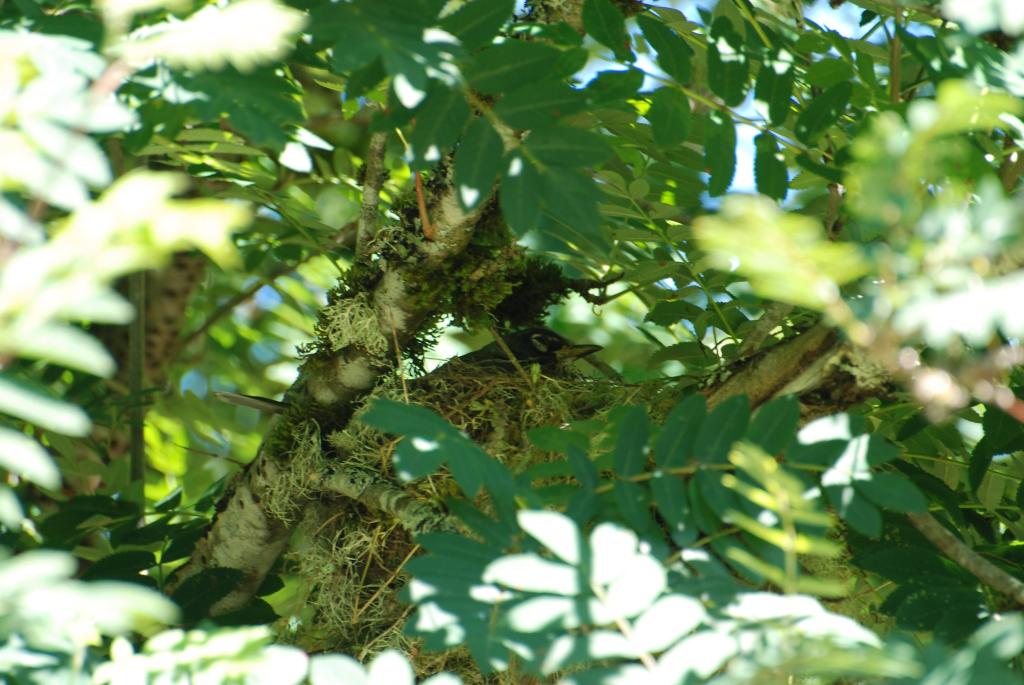
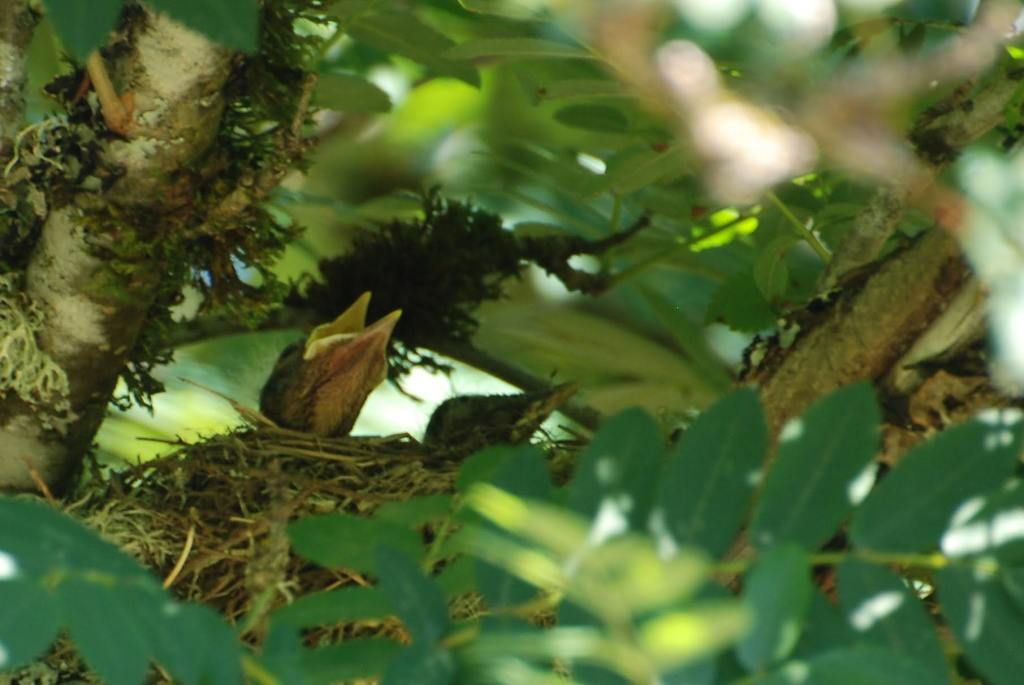
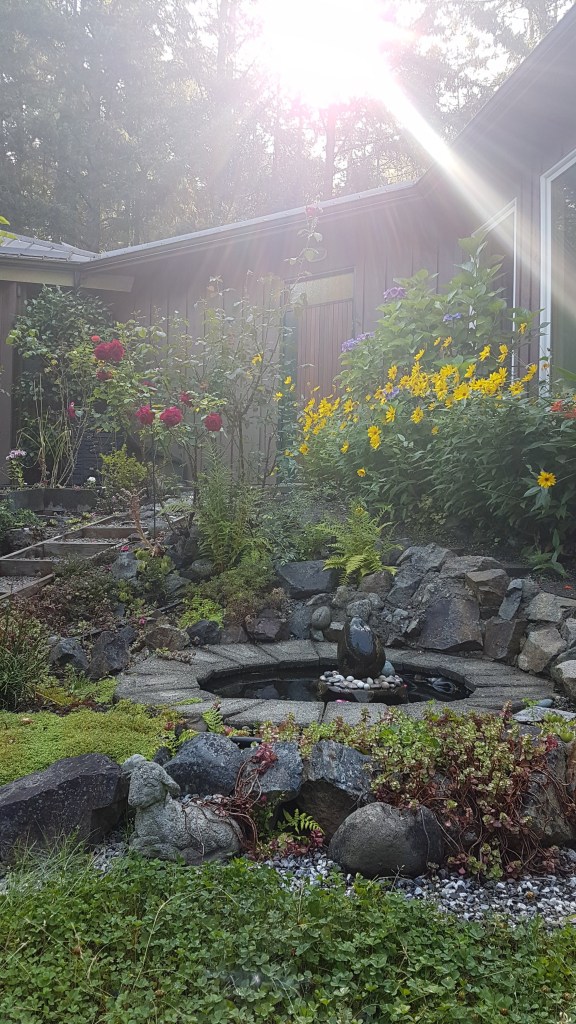
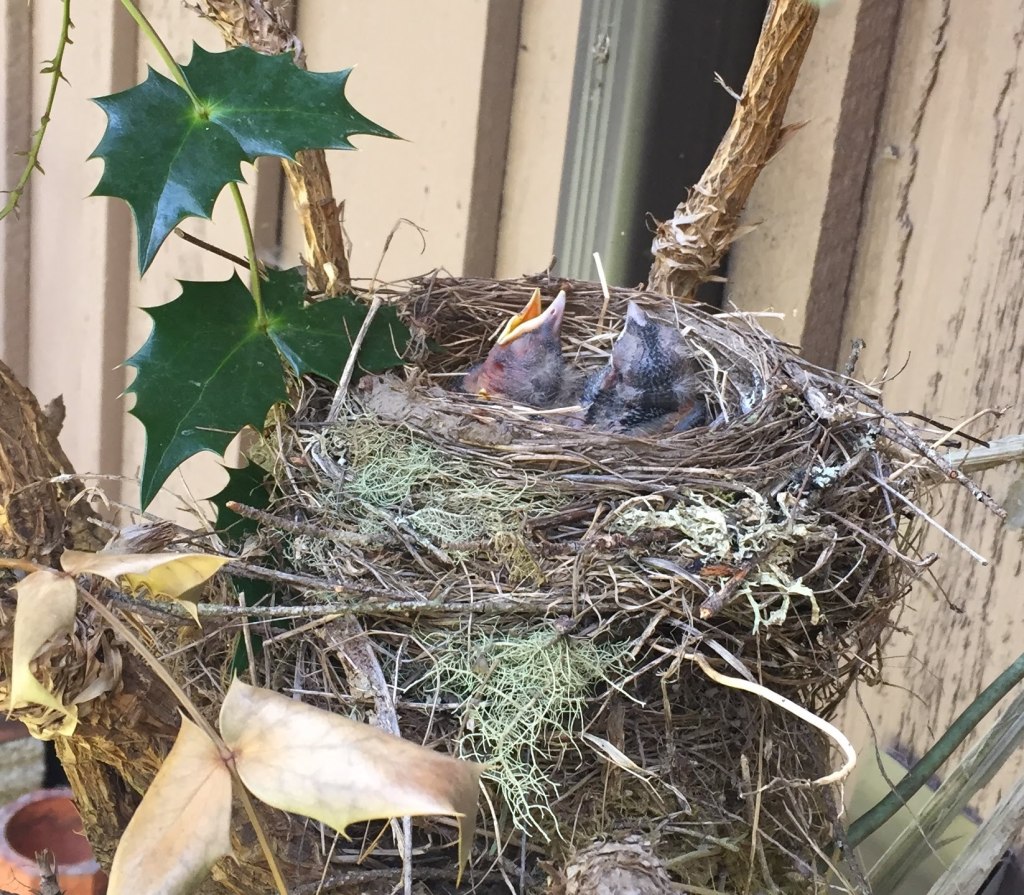
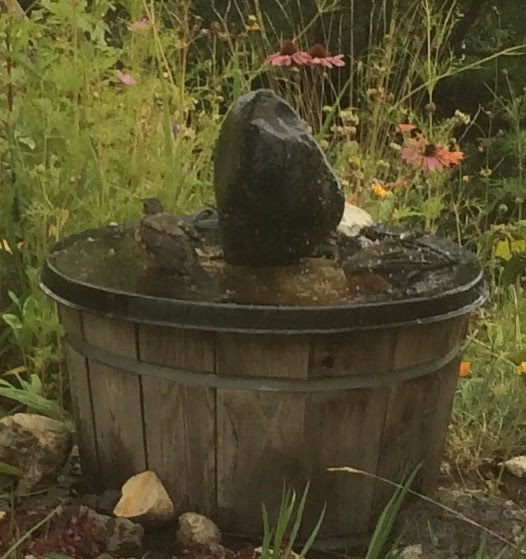
The first encounter was during a dark and thunderous time. After a separation from my husband, I had moved to the rolling hills of the Cariboo. My new home was perched atop a collection of hills where you could see for miles as the thunderclouds glided , danced , and released . It was a dramatic location. As I settled in, every time I went out front, two Robins would dive at me. I was setting up my rock water fountain on the front porch by the lilac bush. It was a river rock with a hole in it and water came up through its center. It sits on a block, in a half oak barrel filled with water. Over time this rock has been sculpted by the water. In the mornings I love to watch nature in action over a cup of coffee. I noticed the Robins kept coming to the lilac bush, so I crept up to the window beside the door and peered into the branches. There they were, three blue eggs. No parents were near so I carefully pruned away a few branches so the sight lines were clear from inside the house. Of course we missed the hatching but my two children and I watched the chicks develop. It was a new beginning for us and we delighted in watching them grow so quickly. I revelled in the birth of this new life for both me and the birds.
I had the good fortune to be given a vacation for the three of us to visit family in Bermuda. So book in hand (Pema Chodron’s When things Fall apart) we departed. The trip was a time of awakening for me as I grieved the loss of my marriage and learned about living in the moment rather than always craving what I don’t have and pushing away my aversions.
After our return from Bermuda the robins had gone! I was sad to have missed their fledgling flight. The kids went to visit their dad and I had time alone to process. I looked for young robins, as I gardened. Then as I cleaned out the water from the fountain, I found them. . . ,
3 young robins, dead, in the fountain’s water barrel. I was crushed as it triggered so many emotions. Death of a marriage, loneliness, anger at myself for having the fountain so close to the nest. It helped me see my attachments and reveal the cycle of life and death. I was beginning to let it all go.
Pema Chodron’s book put me on the path of meditation. The following summer I went to my first 10 day sit at a Vipassana meditation center near Merritt. I discovered the simple delight of living in the moment and realising the pain shall pass. This was where I had my next encounter.
As I tried to meditate in my room, I heard birds chirping. They were in the bush right beside the window. I could barely see the beaks but could hear their calls as the parent Robin arrived with food. They were in this perfectly protected place. The courtyard is surrounded by the building so no predators could go there, not even humans during the course. I was building protection for myself.
Once I returned home, I was enjoying a coffee and looking out my window at the water fountain. It now had a large rock at the base so that nothing could drown. And there they were! Two Robins, sitting on the rock bathing and fluttering their wings in the fountain. The shock and pleasure took me by surprise with joyful tears. It was like a re-birth.
Nine years ago, I moved to Shawnigan Lake and helped with the opening of a new meditation center in Duncan. I donated my rock fountain and it sits in the protected courtyard. I also discovered a robin’s nest which had chicks in it during my first sit there. At every new change in my life they remind me of where I’ve come from.
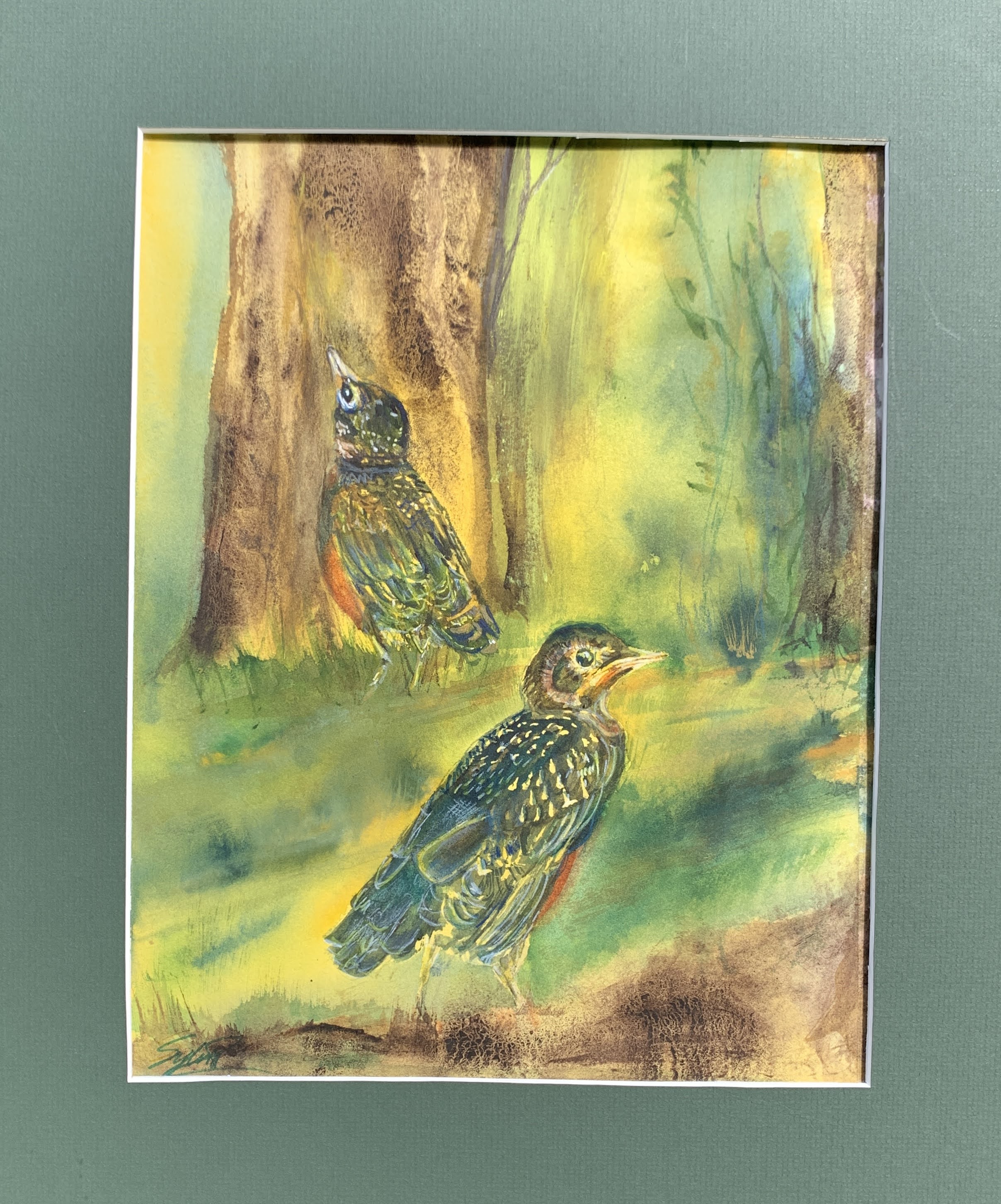
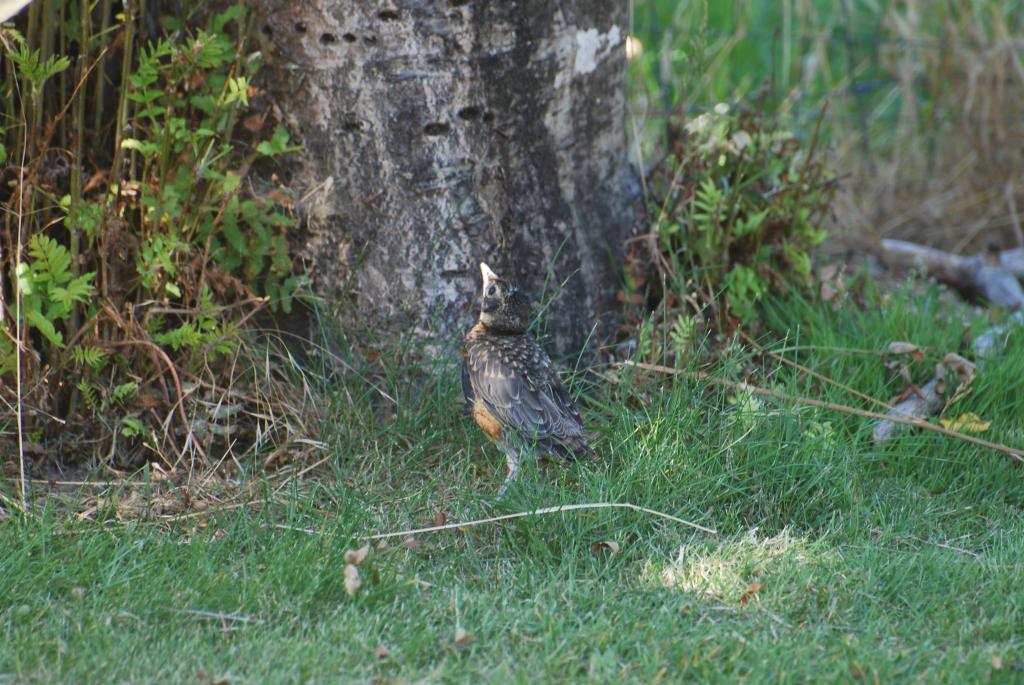
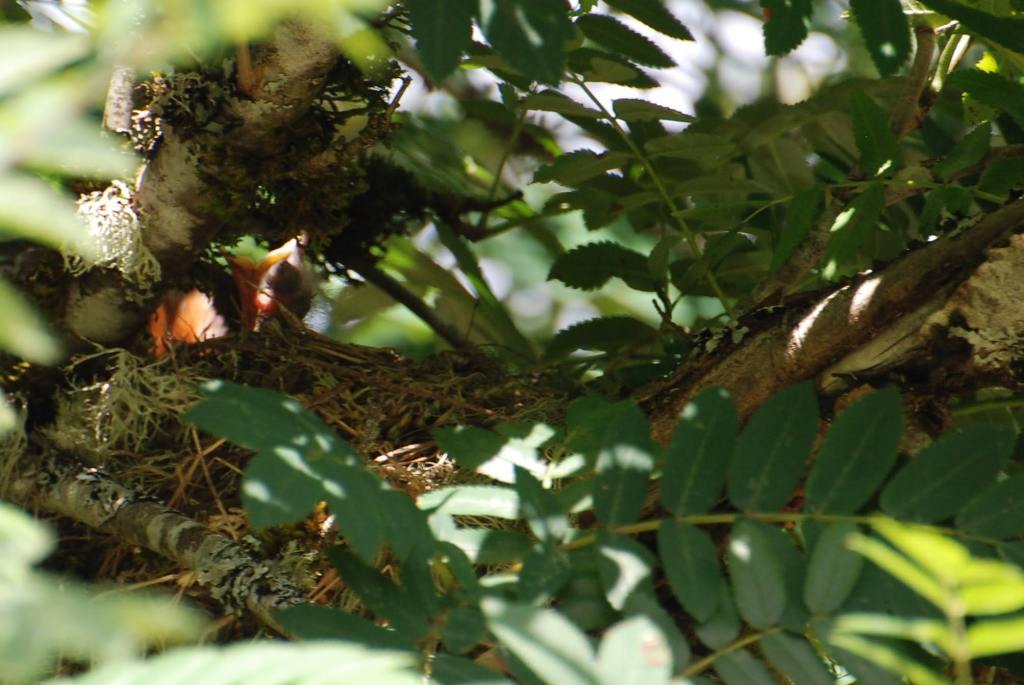
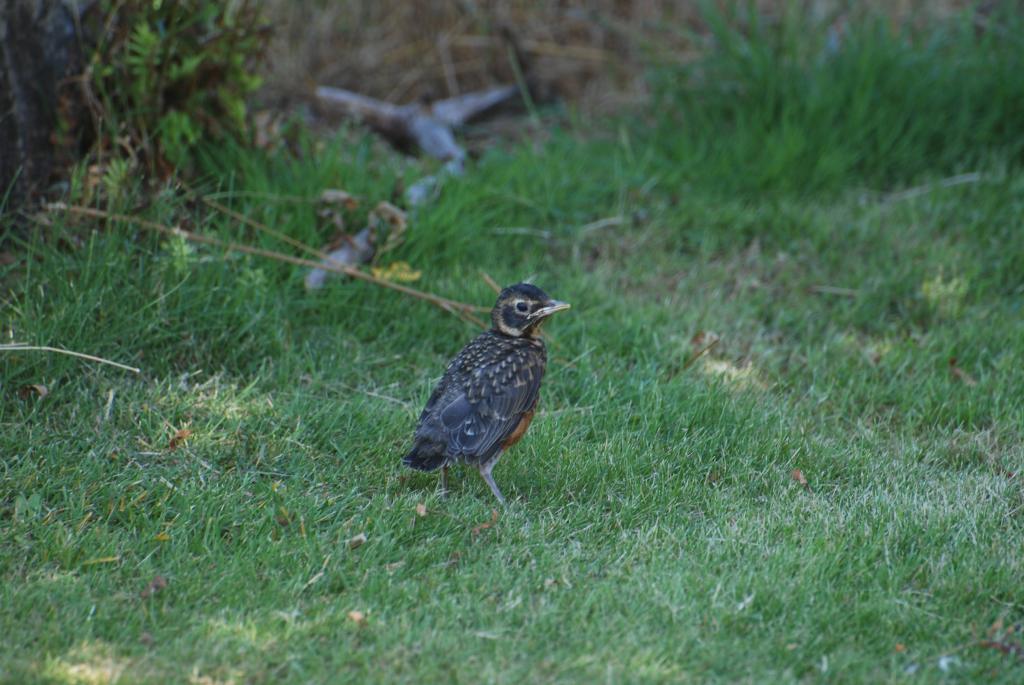
In my last year of teaching I discovered a nest in the Rowan tree in my front yard. I once again watched and took pictures. Then as I retired I saw the fledglings land on the ground. One wanted to go back up into the tree but the other hopped after its parent down my driveway.
I am on my own now. Strong enough to not need protection.
The robins helped me grow to see new perspectives in each and every moment.
The Rain Bird
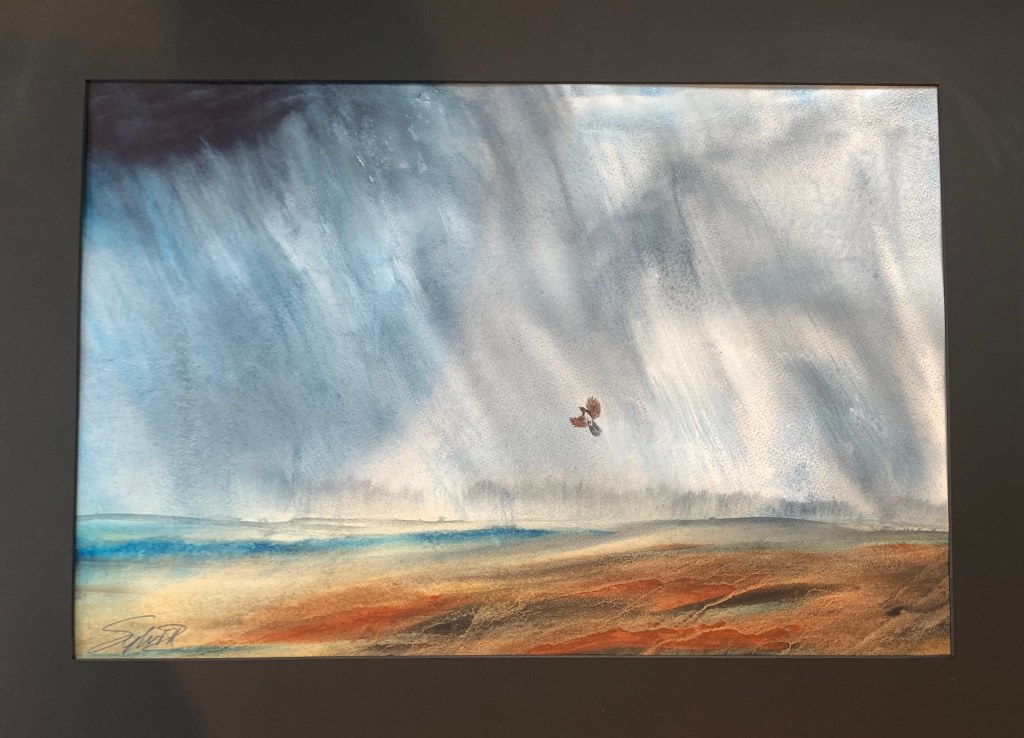
Audio of The Rain Bird- Thankyou to the Nal’bali stories
Read the Rain Bird
Twice adapted from Joanne Bloch (retold folktale) & Nal’ibali websiteProgram to promote reading in South Africa.
In Africa, in a country called Gabon, a little village stood at the very edge of a forest. In the heart of this forest, in the highest branches of an enormous tree, lived a very special bird − the bird that made rain. For as far back as the villagers could remember, they had taken the time to keep this bird happy. They saved scraps of bread, pieces of fruit and fresh coconut milk, and every week or two a group of villagers took these delicacies into the forest. When they had laid them at the base of the tree, one of them played a simple tune on the thumb piano.
After a while, the bird flew down to the ground to eat and drink. When she had finished, she began to sing the most beautiful song.
Oohhhh whoola, whoola, Oooooo whoola whoola
Oohhhh whoola, whoola, Ooooo whoola whoola
At the same time, she raised her shiny copper wings, and within minutes, the rain began to fall.
This went on for many years. Because the rain fell regularly, the crops grew abundantly and there was plenty of food in the village. But gradually things began to change. Somehow, the villagers were always busy and they began to neglect the rain bird. “It will rain anyway,” they said. “It’s time to stop spoiling that silly old bird!”
But the people were wrong. When they stopped looking after the bird, the rain stopped falling. The crops began to dry up and die, and the animals grew thin and weak. Still, nobody in the village went into the forest to feed the bird that brought the rain. Now they were all too busy trying to find money to buy food in the neighbouring town.
Much later, one scorching day, a young girl called Ketti decided to go into the forest after school. “At least it will be cool in there,” she thought. She walked and walked, and after some time, she came to the tall tree in which the rain bird lived. Ketti stared up at the tree. Suddenly, she remembered how her granny had taken her into the forest to feed the bird when she was still a tiny child. Ketti opened her school bag and pulled out a piece of bread left over from her lunch. Carefully she laid the bread at the base of the tree. Then because she had no thumb piano, she sang an old song that she had known all her life.
“Il Oh ya, oh yay
Oh ya oh yay yay
With a loud whooshing sound, a beautiful bird swooped out of the branches above Ketti’s head and began to eat the bread. When the bird had finished, she opened her mouth and sang “Oohhhh whoola, whoola, Oooooowhoola whoola”
Then she raised her shiny copper wings and all of a sudden Ketti heard the rumble of thunder. By the time she reached her home, giant rain drops were pelting down, cooling the baking red earth.
Ketti was very happy, until she told her parents what had happened.
“Don’t be silly!” scolded her mother. “Nobody believes that bird has anything to do with the rain anymore!”
“Your mother is right,” said Ketti’s father. “The drought has been broken now and we will be fine. Don’t go wasting good bread feeding that greedy old bird again!”
Though Ketti didn’t argue with her parents, she felt sure they were wrong. “If only Granny were still alive,” she said to herself, “she would have believed me!”
But Ketti’s granny had died a few years earlier. The only thing Ketti had left was her granny’s old thumb piano.
Two weeks passed and there was no more rain. The crops began to shrivel up again and the hungry animals’ ribs began to stick out even more. The sun beat down mercilessly from a glaring blue sky.
“I don’t care what they say!” thought Ketti. “We need rain. I’m going to feed the bird again tomorrow!”
So, early the next morning, after taking a slice of bread and a handful of red berries from the kitchen, Ketti slipped out of the house. She began to make her way to the centre of the forest.
What she didn’t realise was that her father was also awake. When he saw what his daughter was doing, he realised that she was going to feed the rain bird again.
“I’ll teach that child a lesson!” he said to himself angrily. He snatched his bow and arrows and silently followed Ketti into the forest. Just as the bird flew down to eat the food that Ketti had set out for it, her father raised his bow and released his deadly arrow. The arrow flew straight into the bird’s heart. The bird let out a piercing shriek. “BooooH”
Terrified, Ketti spun around, just in time to see her father fall down, unmoving. Ketti screamed and turned around, just in time to see the arrow fall harmlessly from the bird’s body. Then the bird, unharmed, swooped up into the highest branch of the tree.
Ketti raced out of the forest to a scene of utter devastation. Every animal and every person she saw lay on the ground. With a pounding heart, she ran all the way back to her home. She quickly found her granny’s old thumb piano. “This is my only hope!” she thought. “The rain bird is angry. I have to make her happy again! I HAVE to!”
Half an hour later, Ketti was back at the base of the big tree. Her body was drenched with sweat and she was gasping for breath. A few paces away from her lay the lifeless body of her father. Ketti looked away quickly, and with trembling hands, began to play the thumb piano. She played and played, until her fingers hurt.
Finally, what she wanted most in the world happened. Down swooped the bird as if nothing had happened. The bird ate some of the berries still lying on the ground and sang a few notes. Then, as Ketti played on, the bird raised her wings. Ketti heard a rustle behind her.
It was her father who had woken up!
“I’m sorry!” he said again and again to the big bird. Then he held out his hand to his daughter and they walked slowly back to the village. In the village all the people and animals were awake again.
That night the villagers held a meeting. They all agreed that they had learned a valuable lesson.
And from that day onwards, not one week passed without a special trip to the forest to feed the bird that brought the rain.
Hadley and the Quail

Listen to Hadley and the Quail
Read Hadley and the Quail
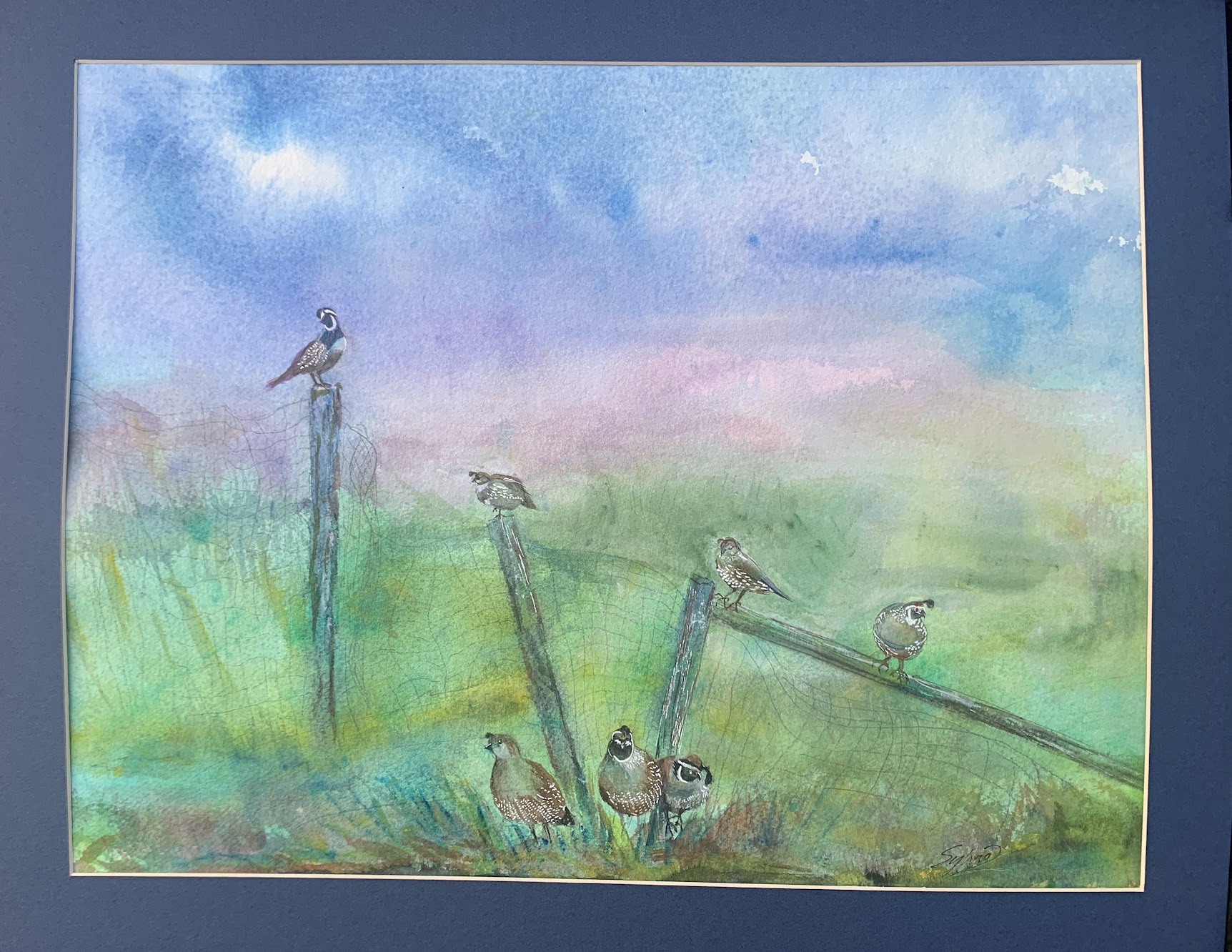
I would watch them from my empty nested window. It has been 9 years now since my own flock fled, and I moved here to Shawnigan Lake. I first saw the Quail the morning after I moved in. I chose this place because of the bird feeder in front of the big picture window. I delight in seeing their bobbing head feathers. Thnnnnnttt, thnnnthuh, satisfied eating noises. Pip pip pip pip pee, their worry or alarm call. And when they had chicks! The adults would watch over high on a post Ka-Kah-ko, ka-kah-ko or ki ka choo, ki ka choo, to gather their covey. And watch them run; it’s like their heads shoot forward and their feet follow. How they would flee at the tiniest of movements “ whou, whou, woo, woo,wooo or freeze in place. I would count them daily to see how many chicks survived from the day before. They became a substitute for my children.
Two large yogurt containers of bird food go into the feeder each day, with half of one spilled on the ground for the quail. They now over winter in this place. I wonder if I’m disturbing nature’s natural cycle? But I reason that if the meadow had not been harvested, there would have been grain for them all. I am simply replacing what has been taken.
I’d often sit in my chair hammock as still as can be and watch them graze along right under me. Such joy to be still enough and not be noticed. I am no predator.
Once I came around the outside of my home and I scared some of the babies. The door was open and they ran into my studio. And boy oh boy are they good hiders. I managed to catch a couple by the window. I had no idea how many were in there. Every time I thought I’d got them all I would hear a chirp. I found the last of one of 6 which chirped the next morning. I had to sit on the ground with a blanket for it to run by as I covered it with a dishcloth. Once outside it took awhile to come out of freeze mode and find a bush.
My art studio has windows on three sides. I often find juncos and finches caught in there. I would throw a tea cloth on them, gently hold them and release them back outside. I now have beads covering my outside door, to allow fresh air but to dissuade birds from flying in.
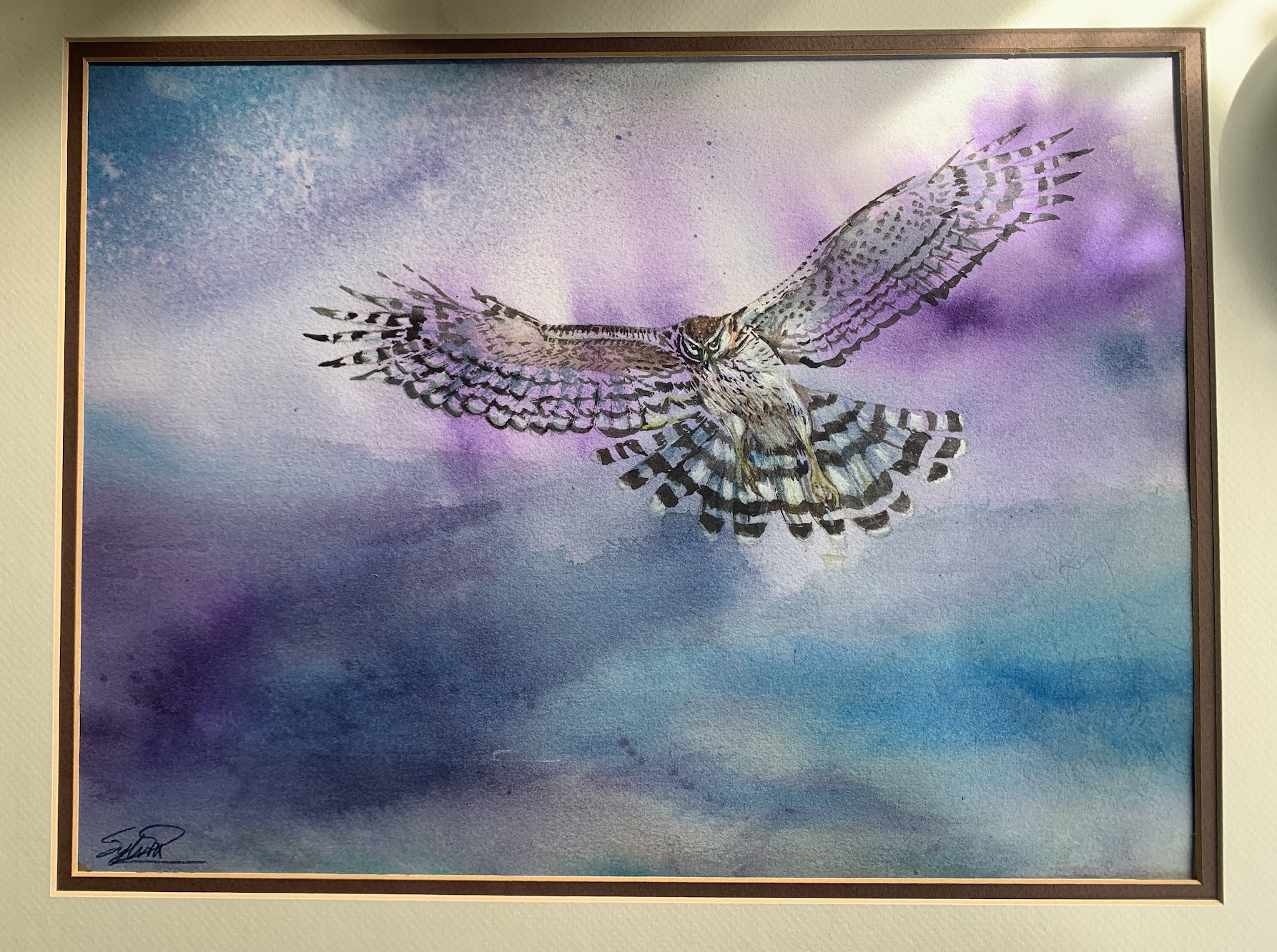
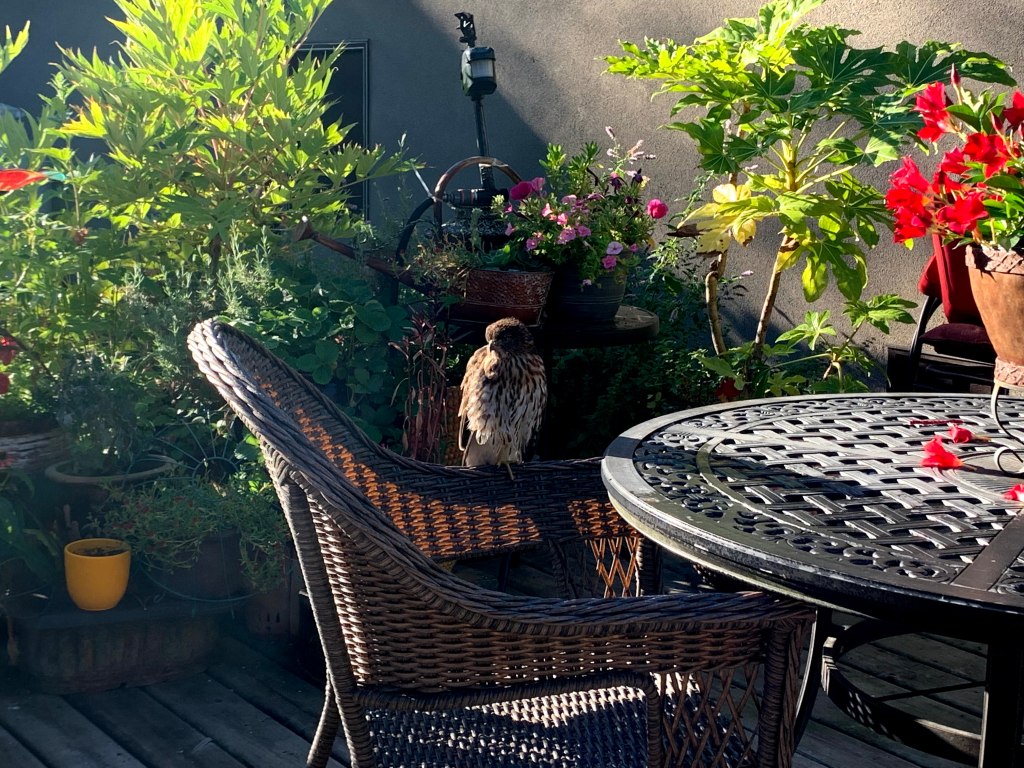
Then one day Hadley landed on my garden table only a couple of meters from my hammock. She just sat there, quite puffy with young downy feathers, a raptors beak and striped tail feathers. She was a Cooper’s hawk and probably a juvenile. I managed to creep slowly towards her, taking pictures at every step. She was not bothered by me at all. I got within a few feet of her and she jumped onto the deck. She scraped her long talons as she hobbled between the plant pots looking for juncos and finches to hunt. She became a regular visitor every morning, allowing me to come close every day, often perched on a chair back or the roof of my car. I am no predator
Whenever she came round the other birds would disappear quickly with the quails warning sound. Pit pit pee, pit pit pee. Whoo whoo, woo, woo, woo. In she’d fly with her large wide wings and those lovely tapered wing tips, hovering and landing with talons on the chair back.
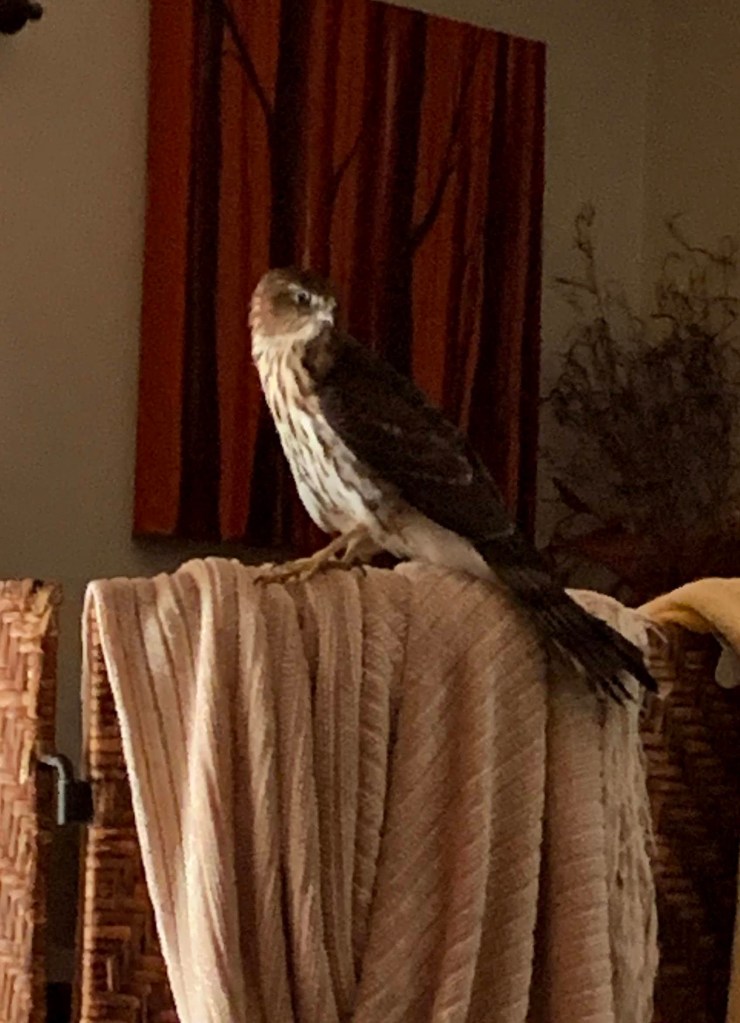
One cloudy day I’m inside by my window and I hear a flutter. Oh boy, it’s another bird. I get up and see Hadley on my rattan divider in my bedroom! She must have walked in through the beads. There’s no way I can throw a tea towel on her! She flew into the studio and landed on my pastel poppies. Each time I moved she flew toward a window. I took the beads off the door, grabbed one of my driftwood sticks, and gently put the stick under her feet. Eventually she perched on it. In that moment I didn’t dare look at her eyes, I focused on her feet, willing her to stay on for our success together. In slow motion I rounded the door and exposed her to the outdoors. She pushed away from the stick freely, releasing herself to the roof of my car to compose herself . What an experience! She was so heavy, it took two hands to hold up the stick. She had trusted me.
But then one morning, with morning coffee and window gazing. Quail feeding thuh, thuh, thuh. Happy eating sounds
In swoops Hadley from around the corner of the building
Quail flee. BUT this time, one is caught.
Hadley sits on it, looks around,
backs up into the bushes,
somehow aware of my sadness, and rips and feeds.
The Lae Lae Bird
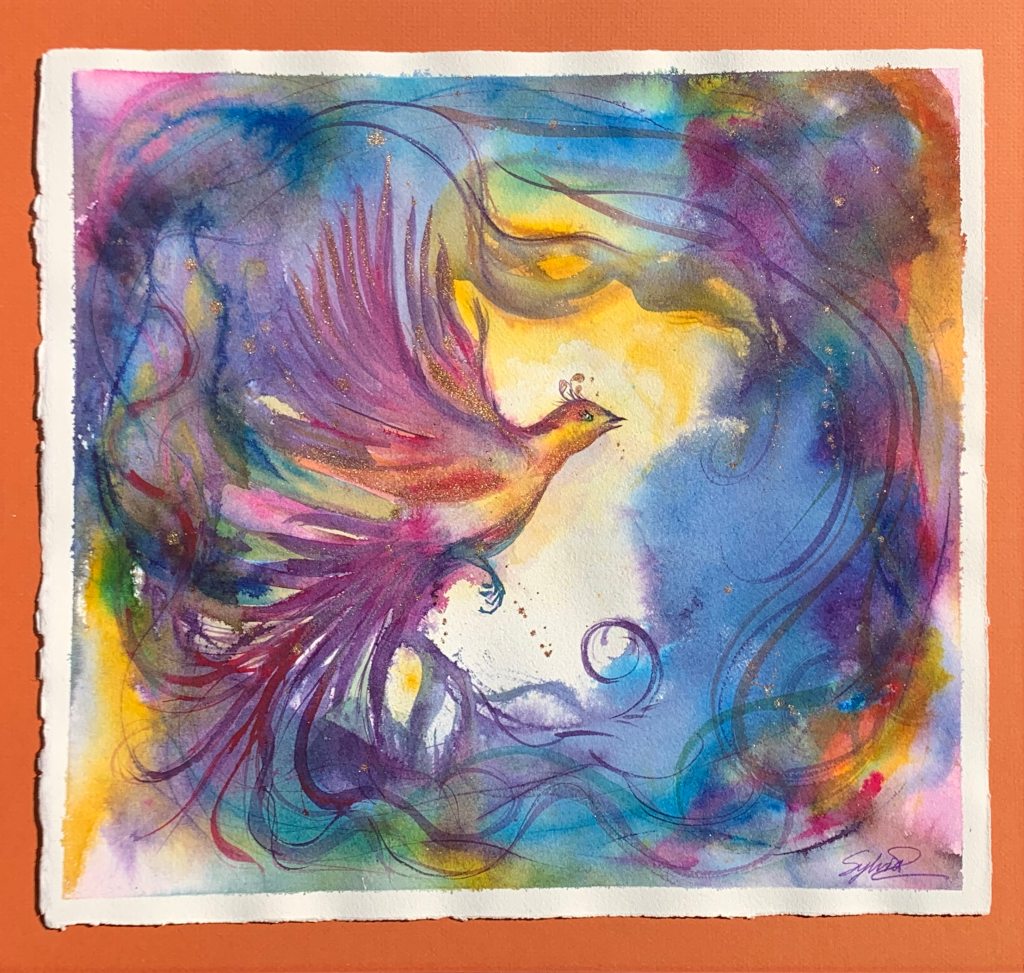
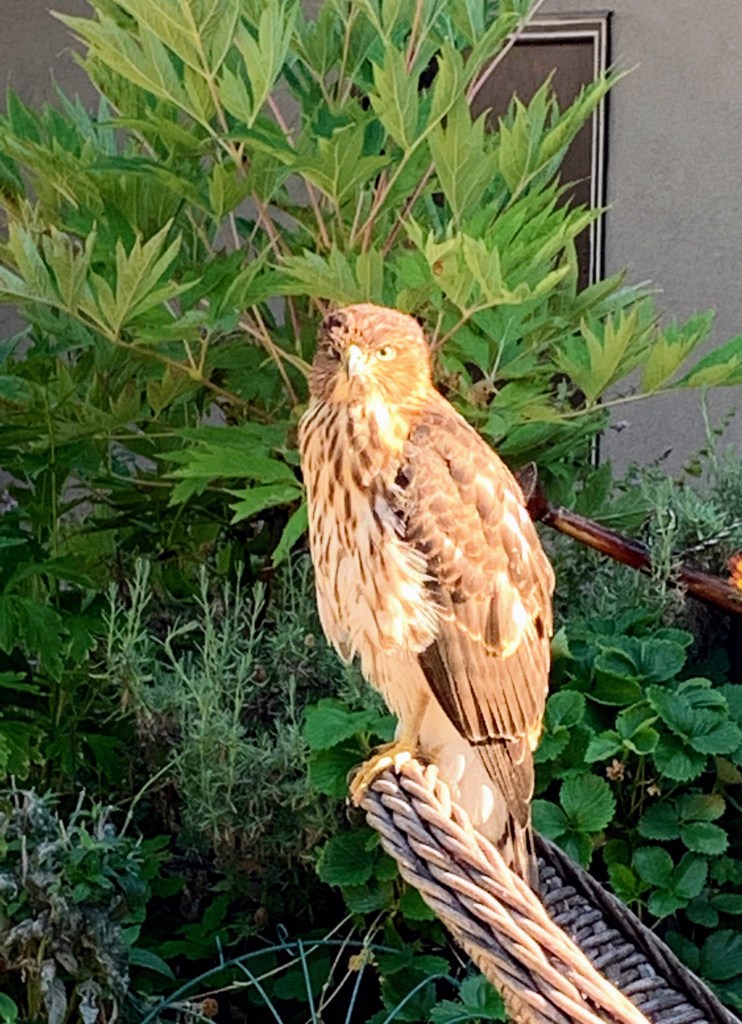
Here is one of my favourite stories that I have been telling for over 30 years. It came to me from a friend in my teacher education program. A group of us told it together for a music assignment and I have been adapting it ever since. Here I am painting it with a recording. This is a tale from Thailand, called The Lae Lae Bird.
Read the Lae Lae Bird
Adapted from a Tale from Thailand
Once upon a time there was a golden throated Lae lae bird that sat perched atop a tall tree singing this song from the top of his lungs.
Lae lae lae..
One day a Hunter came along. At first he heard the beautiful bird and when he saw her magnificence he decided that he had to have it for himself . So he set about making a trap using ginger root. But that Lae lae bird was very smart and daring, for she flew down, grabbed that ginger root without getting caught.
This frustrated the hunter and so he decided that if he couldn’t have the bird alive he would have it dead. So he took his bow and arrow, lined it up and shot that Lae lae bird right through her heart. She fell to the ground, he grabbed her by her tail feathers and threw her into his hunting sac. But as he was walking along the song still came up from the bottom of his bag.
Lae lae lae ( hummed)
When he got home the hunter took that bird out of his hunting and sac threw her onto his chopping block and chopped her up into a million little pieces. But still the song went on.
Lae lae lae (short staccato)
Well he took that meat and threw it into a pot, added spices, some vegetables and let it bubble away. But still the song came bubbling up from the bottom of the pot.
Bloop bloop bloop. . .
So he decided to eat that soup. He took his spoon, dipped it into the pot, placed it in his mouth and down his throat the bird passed. Needless to say that Hunter had a very restless night, for deep in the bottom of his belly this song came up.
Lae lae lae( retching up the song)
Well that morning the hunter went to his out house and relieved himself thinking, “At last I’ve heard the end of that miserable bird.” Soon after, a friend came along and said what’s that sound I hear coming from your banana grove? And sure enough he heard it whispering through the grove.
Lae lae lae (soft and ethereal)
By this point the hunter was enraged. So he took his shovel and scooped up that ‘compost’ and put it into a trunk. He chained it up and pushed it down the river, it went all the way to the ocean and floated for three full years until it landed on an island where a Hermit magician was meditating. Magically he opened the trunk and out flew the Lae lae bird. It flew all the way across the ocean, all the way down the river and all the way back to that hunter’s house where he haunted him for the rest of his life, singing.
Lae lae lae
And that is the tale of the Lae Lae Bird


 Sylvia's Studio and Stories